
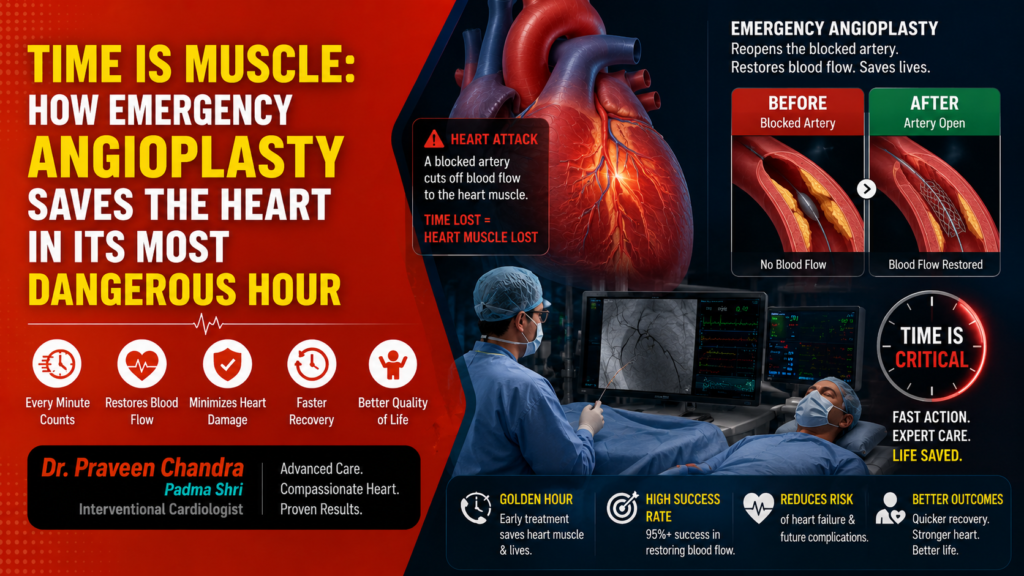
Somewhere in the wall of your heart runs an artery no wider than a drinking straw. If a clot were to seal it shut this afternoon, a clock would begin to run, and it would not be a gentle one. Within twenty to thirty minutes, the muscle fed by that artery would begin to die, cell by cell, and it would go on dying for as long as the vessel stayed closed. In my field, we have a blunt phrase for this: Time is muscle.
It means that during a heart attack, the clock is your enemy. Every single minute that blood flow is blocked, a piece of the heart muscle quietly suffocates and dies, resulting in damage that no modern procedure can reverse.
But it also carries a truth that catches many of my patients by surprise. In this critical emergency, the medical outcome isn’t just decided by the technology in my operating room; the clock decides it. What you do in the first sixty minutes, recognising the signs and seeking immediate care, has as much impact on your survival and long-term recovery as any advanced intervention I can perform afterwards.
What Is Actually Happening Inside Your Chest
A heart attack is, at its heart, a plumbing failure. The coronary arteries are the intricate network of vessels responsible for feeding the heart muscle itself. Over decades, these pathways can quietly silt up with fatty deposits known as plaque. A heart attack begins the moment one of these deposits ruptures. Mistaking this crack for an open wound, the body rushes to seal it with a clot. If that clot expands to block the artery entirely, the heart muscle downstream is instantly choked of oxygen.
That is the exact second the clock starts. The specific territory served by that blocked vessel, whether a localised patch or a massive swathe of the front wall supplied by the artery we grimly nickname the widow-maker, begins to starve.
If we restore blood flow quickly, the muscle survives. If we wait too long, that living tissue dies and is permanently replaced by rigid scar tissue, and a scar tissue cannot pump. This is why the entire paradigm of modern heart-attack care is a relentless race against a single, unforgiving enemy: delay.
The Heart Attack That Does Not Look Like One
Here is the first thing too few people know, and it costs lives every day: the cinematic heart attack, a person clutching their chest and collapsing to the floor, is only one face of the crisis, and often not the most common.
A great many heart attacks arrive quietly. They mask themselves as a heavy discomfort easily mistaken for indigestion, a sudden breathlessness on the stairs, a cold sweat, or a bone-deep fatigue. Sometimes, the pain bypasses the chest entirely, settling instead in the jaw, the shoulder, an arm, or the upper back.
Women, in particular, are far more likely to experience these atypical warning signs. Landmark data shows that more than forty per cent of women experiencing a heart attack feel no chest pain whatsoever. Patients living with diabetes are similarly deceived; the very condition that compromises their arteries also blunts the nerve pathways that would otherwise sound the alarm.
Some heart attacks are so deceptive they are only discovered weeks later as an unexpected shadow on a routine electrocardiogram. We call these “silent” heart attacks, but they are silent only in the sense that the patient didn’t know how to listen.
The Mistakes That Turn a Survivable Attack Into a Fatal One
If the disease is a race against delay, the tragedy is how readily we hand it a head start. The most common error, and the most Indian, is to explain the symptom away. It is only gas, we tell ourselves, only acidity, and we reach for an antacid and lie down while the clock runs on unopposed. I have lost count of the patients who arrived hours too late because they waited for the discomfort to pass. The second error is to drive to the hospital, or to let a frightened relative drive. Please do not. A person in the throes of a heart attack can lose consciousness without warning, and a moving car is a dangerous place for that to happen. And there is a piece of folklore I must lay to rest, because it circulates endlessly on our phones. You may have read that forceful, repeated coughing can somehow carry you through a heart attack until help arrives. It cannot. So-called cough resuscitation is a myth, and obeying it squanders the one thing you can never earn back, which is time.
Why the Ambulance Is Already Part of the Rescue
The moment you dial for emergency services, your treatment has already begun. A modern medical crew operates a mobile extension of the hospital itself. They can perform an electrocardiogram right at your bedside, instantly recognise the signature of a major heart attack, and alert the hospital. This simple call ensures that the catheterisation laboratory is fully prepped and waiting before you even cross the threshold, saving precious, life-saving minutes at the door.
On the way, they can initiate critical medications. More importantly, if the heart slips into ventricular fibrillation- the chaotic, quivering rhythm that causes most fatalities in that first hour- they carry the defibrillator that can shock it back into order within seconds. That electrical reset, and not a forceful cough, is what saves a life in that moment.
While you wait for help to arrive, if you have no known allergies, chew a single ordinary aspirin to begin slowing the clot’s growth, though you must never delay the emergency call to search for one. Stay as calm as possible, and unlock your front door so help can reach you without delay.
The Rescue: What Emergency Angioplasty Actually Does
When you reach us in time, this is what follows. The procedure is called primary angioplasty, or primary PCI, and it is the most direct answer that medicine has to a blocked artery. Through a puncture at your wrist, we pass a fine wire and a catheter up to the heart and steer them, under live X-ray, to the very clot that is starving your muscle. Inside the catheterisation lab, the intervention is a masterpiece of precision. A small balloon is inflated directly at the site of the blockage to press it aside, and a stent, a microscopic scaffold of metal mesh, is left in place to permanently hold the artery open. The moment that vessel clears, blood floods back into the starving muscle, and the tissue damage stops instantly.
A single metric governs this entire operation: door-to-balloon time. Our absolute target is to open that blocked artery within ninety minutes of a patient stepping through the hospital doors, because the clinical evidence is unforgiving. Every thirty minutes of delay raises the risk of mortality by roughly a tenth. An artery opened swiftly is very often a life returned to its full length; the same artery opened too late leaves a heart permanently weakened by the wait.
What the Heart Can Still Recover
There is a mercy in the biology that rewards speed. Muscle starved of blood does not all perish at once. For a while it can enter a kind of suspended stillness, alive but not working, what we call stunned or hibernating muscle, and if its blood supply is restored quickly enough, it can wake and beat again as though little had happened.
This is the quiet miracle of a fast rescue, and it is the whole reason I plead with people not to wait. Every minute you give the artery back is a minute of muscle you may keep for the rest of your life.
Why This Is, Above All, India’s Emergency
We must speak honestly about our own country, because the realities of heart health in India are sobering, and they belong to us. Statistically, Indians develop cardiovascular disease nearly a decade earlier than Western populations. Today, heart attacks are routinely appearing in men and women in their thirties and forties, individuals who quite naturally believe they are far too young to be at risk.
Beyond biology, we also face a cultural inclination to delay. As a people, we tend to wait for an elder’s advice, for a family member to arrive home, or for the working day to close. We look for reasons to pause, arriving at the hospital only after irreversible damage has already been done.
If there were a single collective habit I could change across our entire nation, it would be this instinct to “wait and see.” When it comes to a heart attack, waiting and seeing is the most perilous choice a person can make.
Why This Work Belongs at Medanta
For all that you can do, there comes a moment when the heart must be placed in the hands of a team that does this every day and every night. Emergency angioplasty is not a booked appointment; it is a state of readiness, a catheterisation laboratory and a heart team able to spring to life at three in the morning as surely as at three in the afternoon. I have spent my career in these arteries, and at Medanta this rescue sits within a round-the-clock interventional and structural programme built precisely so that when a heart attack comes through the door, the ninety-minute clock is already being beaten. The skill matters. The speed matters more.
So let me end with the plainest counsel I have ever given. If you feel a pressure or heaviness in your chest, a breathlessness, a cold sweat, or a strange pain in your jaw or arm that will not settle, do not talk yourself out of it, do not drive, and do not waste time coughing or waiting to see if it passes. Call for an ambulance at once, chew an aspirin if you safely can, and let us do the rest. A heart attack is one of the few catastrophes in medicine that a person can help to survive by a single, timely decision. Make it early. Time is muscle, and the muscle is yours.