
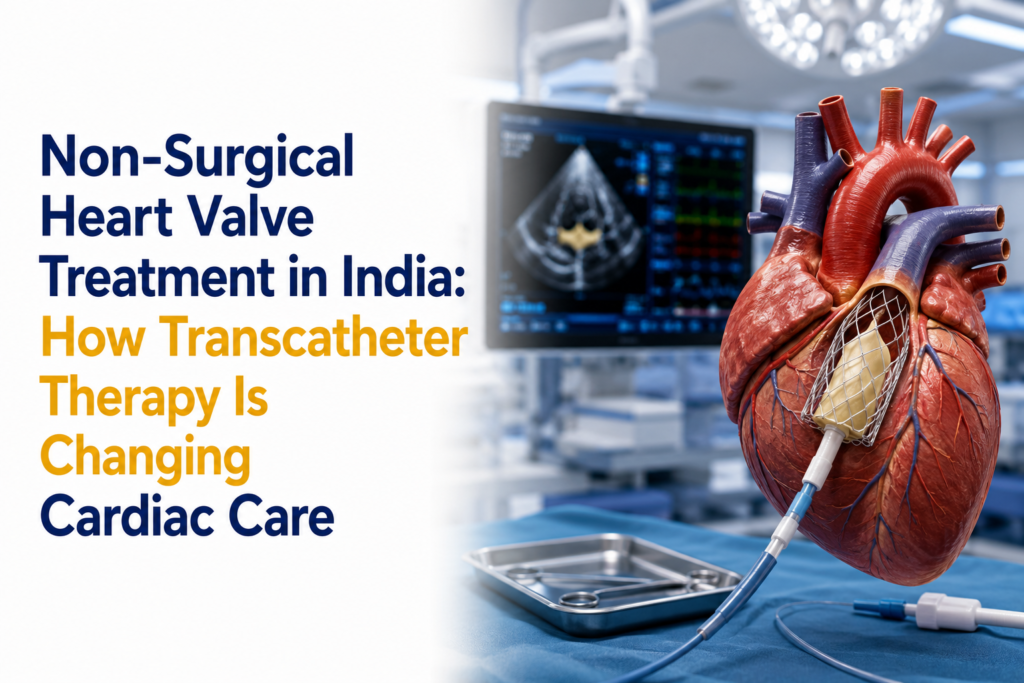
Across more than twenty years as an interventional cardiologist, in which I have personally performed over a thousand transcatheter valve procedures, I have watched heart valve treatment change more completely than any other part of my field. When I trained, a diseased valve meant open-heart surgery, or, for the many patients too frail to survive an operation, no treatment at all. A patient with severe, untreated aortic stenosis and symptoms faced roughly a fifty per cent chance of dying within two years. Today we can repair or replace all four of the heart’s valves through a slender tube, without opening the chest, often while the patient lies awake, with the majority home within two to three days. What follows is a complete, evidence-based guide to non-surgical heart valve treatment: what it is, its history, what the trials actually show for each valve, the innovations behind it, the hard numbers on valve disease in India, and the honest limits that remain. I have written it to serve two readers at once, the patient weighing their options, and the young cardiologist learning this craft.
What Is Non-Surgical (Transcatheter) Heart Valve Treatment?
The proper name for this field is transcatheter valve therapy. The principle is simple. Rather than reaching a diseased valve by opening the chest and stopping the heart, we reach it from within, guiding fine instruments to the heart through the body’s own blood vessels, usually from a small puncture at the wrist or at the top of the leg, and sometimes by crossing from one side of the heart to the other through its inner wall. Once we arrive, we can do one of two things. We can repair the patient’s own valve, for instance by drawing its leaking edges together with a small clip, or we can replace it entirely, seating a new valve of treated animal tissue inside the old one. The patient is most often awake or lightly sedated, feels very little, and returns home within a few days rather than the weeks that open surgery demands, because there is no breastbone to divide and heal. That single fact, the absence of a surgical wound in the chest, is what makes these treatments possible for patients who could never have survived an operation.
A Short History: How We Learned to Change a Valve Without a Scalpel
It is worth knowing how recent all of this is, because it reminds us how quickly medicine can move. The idea was long thought impossible. Then, in 1989, a Danish researcher named Henning Rud Andersen sewed a valve onto a simple metal stent and proved, in the laboratory, that it could be delivered by catheter. His work was met with near-total indifference for thirteen years. It was only on the sixteenth of April, 2002, that a French physician, Alain Cribier, placed the first such valve into a living patient, a fifty-seven-year-old man in cardiogenic shock whom every surgeon had refused. That single act opened a new field, structural heart intervention, almost overnight. Two decades on, more than a million and a half patients worldwide have received a transcatheter aortic valve, and the same principle has been carried from the aortic valve to the mitral, and most recently to the tricuspid. I count myself fortunate to have practised through the whole of that revolution, and to have performed the first of these aortic valve procedures in India.
The Aortic Valve: Replacement Through a Catheter (TAVI / TAVR)
The aortic valve, which guards the exit of blood from the heart, was the first to be conquered, and it remains the field’s great success. When it stiffens and narrows with age, a condition called aortic stenosis, the heart must strain to drive blood through a shrinking opening. Severe aortic stenosis affects an estimated three to five per cent of people over the age of seventy-five, and once symptoms appear, the outlook without treatment is grave. We now replace this valve through a catheter in a procedure called transcatheter aortic valve implantation, or TAVI, also known as TAVR. The evidence is emphatic. In the landmark PARTNER 3 trial of lower-risk patients, the combined rate of death, stroke and rehospitalisation at one year was 8.5 per cent with TAVI against 15.1 per cent with surgery, and thirty-day mortality was under half of one per cent. The Evolut Low Risk trial found the same non-inferiority, and seven-year follow-up has shown the valves enduring well. On this evidence, TAVI is now offered across the full spectrum of surgical risk, and the recent EARLY TAVR trial supports treating a severe narrowing even before symptoms begin. Many patients now leave hospital the very next day. For the aortic valve, the non-surgical route has become, for a great many patients, the first choice rather than the fallback.
The Mitral Valve: Repairing and Replacing Without Surgery
The mitral valve, which sits on the left side of the heart and may either leak or narrow, proved far harder, because it is not a simple flap but an intricate apparatus of leaflets, a supporting ring, and fine cords aptly called the heart strings. A leaking mitral valve, or mitral regurgitation, can now be repaired without surgery using a small clip, delivered through a vein, that draws the leaking edges together, a procedure called transcatheter edge-to-edge repair, or the MitraClip. More than 200,000 patients worldwide have now been treated with it. Its value in heart-failure patients was proved by the COAPT trial, in which adding the clip to the best medicines cut the two-year death rate from 46 per cent to 29 per cent and roughly halved hospital admissions for heart failure. For patients whose valve cannot be repaired this way, the first dedicated device for replacing the mitral valve entirely through a catheter, transcatheter mitral valve replacement or TMVR, was approved in May 2025. And where the mitral valve has instead been narrowed by old rheumatic disease, still common in India, a balloon can frequently open it with no surgery at all, a long-established procedure called balloon mitral valvuloplasty. The mitral valve can now be met with a whole family of non-surgical answers, each suited to a different problem.
The Tricuspid Valve: No Longer the Forgotten Valve
The tricuspid valve, on the right side of the heart, was for decades dismissed as the forgotten valve, because it was hard to reach, its disease poorly understood, and almost nothing could be done for it short of major surgery few patients could tolerate. A leaking tricuspid valve causes a miserable congestion of the body, swelling of the legs and abdomen and deep fatigue; in the United States alone, an estimated 1.6 million people live with significant tricuspid regurgitation. The last two years have changed everything. In 2024, for the first time anywhere in the world, two catheter-based treatments won approval: the Evoque replacement valve in February and the TriClip repair device in April. In the trial that supported it, the Evoque valve reduced the leak to mild or less in about 94 per cent of patients at six months. A condition we could once only watch and treat with sympathy, we can now treat with intent. This is the newest frontier of the field, and it advances month by month.
The Hidden Innovations That Make It All Possible
Behind these headline procedures lies a great deal of quieter innovation, and this is the part I find most fascinating, and the part I most enjoy teaching. Before a valve is ever placed, we plan the entire procedure on a detailed CT scan, measuring the target to a fraction of a millimetre. We have learned to position an aortic valve using a particular angled projection, the cusp-overlap view, that keeps it clear of the heart’s electrical wiring; in several series this has roughly halved the need for a pacemaker afterwards, from around 18 per cent to near 11. We deliberately rotate a new valve so its joins line up with the patient’s own, a refinement called commissural alignment, so that the coronary arteries remain reachable years into the future. When an old surgical valve wears out, we can seat a fresh valve inside it, a procedure aptly named valve-in-valve, and if the old frame is too narrow, we can crack it open with a high-pressure balloon to make room, a striking manoeuvre known as bioprosthetic valve fracture. During some procedures, we deploy a tiny filter to catch any debris before it can reach the brain. And our imaging is increasingly guided by artificial intelligence, which helps us plan each case with a precision unimaginable when I began. Each of these refinements makes the work safer and more exact, and together they explain why the results improve almost year upon year.
What I Teach the Cardiologists Who Train With Me
Young cardiologists often arrive expecting to learn techniques, the movements of the wire and the catheter, and of course we teach those with care. But the deeper lessons are about judgement, and those are the ones I care most about passing on. The first is that we treat a patient, and never merely a valve on a screen. The second is that imaging is the master of this work; the operator who truly understands the scan will always outperform the one with the quicker hands. The third is the discipline of the heart team, the habit of deciding every difficult case together, with cardiac surgeons and imaging specialists in the room, so that no patient is steered toward the procedure a particular doctor happens to prefer. The fourth, and the hardest to teach, is restraint, the wisdom to offer a procedure only when it will genuinely help, and to say so honestly when it will not. The fifth is what we call lifetime management, choosing today’s treatment with the next fifteen or twenty years of a patient’s life clearly in view, since a valve placed now will shape every option that comes after it. A trainee who absorbs these principles will serve patients well long after any single technique has been overtaken by the next. This, to my mind, is what teaching in a great structural heart programme is truly for.
Cardiac Care in India: What Every Patient Should Understand
Patients often ask me, sometimes with real anxiety, whether they must travel abroad for treatment of this kind. My answer is a firm no, and I give it with some pride. India has been part of this revolution from early on; I was fortunate to perform the country’s first replacement of an aortic valve through a catheter, and our leading centres now run structural heart programmes that stand comparison with the best in the world, using the same devices and imaging and the same heart-team approach found anywhere. There are particular reasons this matters here. India carries a disproportionate share of the world’s rheumatic heart disease, by some estimates a quarter to a half of the global burden, and this disease tends to strike the young, often in the most productive years of their lives, and women more than men, with a leaking mitral valve the commonest lesion of all. At the same time, as our population ages, the degenerative valve disease of later life is rising quickly. This double burden has, out of sheer necessity, made Indian operators among the most experienced anywhere with difficult and complex valves. A patient in India today can receive care for a diseased heart valve that is genuinely world-class, close to home, and steadily more within reach. That is a change worth knowing, and worth taking heart from.
An Honest Word on the Limits
I would not be a trustworthy guide if I showed you only the bright side, so let me be candid about what these treatments cannot yet do. Remarkable as they are, they are not right for everyone. For a younger patient who is fit for surgery, an operation often remains the wiser course, because a surgically placed valve, and a mechanical one in particular, can outlast the transcatheter kind across the many decades such a patient still has to live. We do not yet know exactly how long some of the very newest valves will endure, and honesty obliges me to say so plainly. Success also depends enormously on choosing the right patient, which is a matter of experience and meticulous imaging as much as of any device. And these are demanding procedures, best performed by teams who do them often, because the same operation carries very different risks in practised hands and in occasional ones. None of this dims the revolution. It means only that the judgement surrounding these treatments matters every bit as much as the treatments themselves, which is precisely why the choice of team is so important.
Frequently Asked Questions
Is non-surgical valve replacement safe?
For appropriately selected patients, these procedures are very safe. In the low-risk TAVI trials, thirty-day mortality was under one per cent, and rates of stroke and serious bleeding were comparable to or lower than surgery, with a far gentler recovery. As with any heart procedure, there are risks, which a heart team weighs openly with each patient beforehand. Safety depends heavily on choosing the right patient and the right team.
How long does a transcatheter heart valve last?
Transcatheter valves are made of treated tissue. The aortic valves have now been followed for seven and eight years in the major trials with durability comparable to surgical valves, and, like all tissue valves, they are generally expected to last well over a decade. The very newest mitral and tricuspid valves are too recent for us to know their full lifespan, which is one reason we still favour surgery for younger patients who have many decades ahead of them.
Am I too old for a valve procedure?
Age alone rarely rules a patient out. In fact, these treatments were designed for older and frailer patients who could not survive an operation, and some of the most rewarding results I have seen have been in patients in their eighties and nineties. What matters is the overall condition of the heart and body, which a proper evaluation will assess.
What is the recovery time after a non-surgical valve treatment?
Recovery is remarkably quick. Many patients sit up the same evening and go home within two or three days, and some leave the very next day. Most return to their ordinary activities within a couple of weeks, far sooner than the six to twelve weeks that open-heart surgery usually requires.
Is TAVI and non-surgical valve treatment available in India?
Yes. TAVI and a growing range of transcatheter valve treatments are performed at leading structural heart centres across India, with the same devices and standards used internationally. Access and affordability have improved considerably over the years, and continue to do so, so that far more patients can now be offered these options than even a decade ago.
How do I know if I might need valve treatment?
The most common early clues are breathlessness during activity that was once easy, unusual fatigue, palpitations, or a murmur a doctor has heard through the stethoscope. If any of these apply to you, the single most useful step is an echocardiogram, a painless ultrasound scan of the heart that shows precisely whether a valve is diseased and how severely.
So if you, or someone you love, has been told that a heart valve is failing, and above all if you have been told that surgery would be too dangerous, please do not take that as the end of the road. Ask to be seen by a structural heart team, and ask them plainly what can now be done without an operation. The answer, more and more often, is a great deal. The most important thing you can do is to be evaluated early, by people who do this work every day and will tell you the truth about your choices. That, in the end, is what good cardiac care has always come down to, and it is what I have tried to offer for the whole of my career.
Dil Se,
Dr. Praveen Chandra