
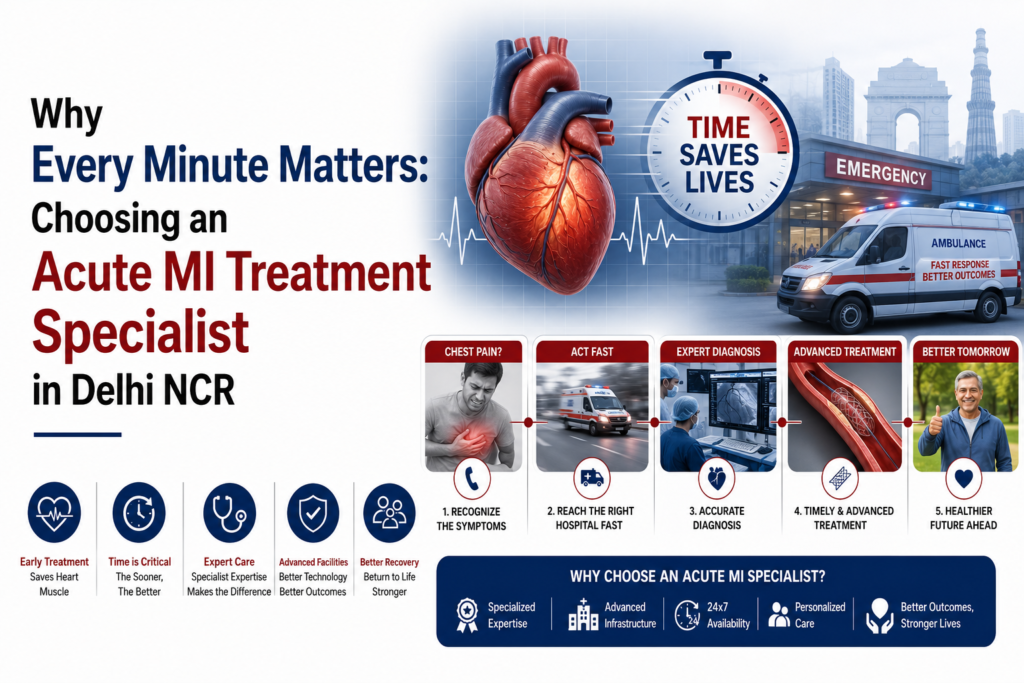
In terms of medical emergencies that call for rapid response, no other medical emergency is more urgent than the Acute MI or heart attack. While some medical emergencies require time to make treatment decisions, an acute MI causes damage to the heart muscle very quickly once there is blockage in the coronary arteries. Any delay could lead to the damage becoming irreversible and result in heart failure, arrhythmia, and even death.
Thanks to the advances made in interventional cardiology, the Acute MI condition no longer holds the threat of being a life-threatening disease. With primary angioplasty, it is possible to clear out any blockage and restore blood flow. But the efficiency of this method is dependent not only on the technology used, but also on the patient’s prompt arrival at an experienced cardiac center offering round-the-clock emergency care.
The selection of an Acute MI treatment specialist in the Delhi NCR region should not be taken lightly by any patient and his/her family.
Understanding an Acute Myocardial Infarction
A heart attack is an event whereby the blood supply to one of the coronary arteries is suddenly cut off due to the rupture of a cholesterol-filled plaque, causing the formation of a blood clot. The lack of oxygen leads to the death of that part of the heart muscle.
The extent of the problem can vary depending on different factors, such as the size of the occluded artery, how long the artery was occluded, and how soon medical attention was sought. The larger the artery occlusion, especially the major coronary arteries, the bigger the damage done to the heart muscles in the absence of quick treatment.
These include pain in the chest, as if being squeezed, breathing difficulties, sweating, nausea, jaw pain, left arm pain, and fatigue. Symptoms will differ according to the patient’s age, gender, and diabetic status.
Nonetheless, the kind of symptom does not change the need for emergency treatment of the ailment.
Why Every Minute Counts
“Time is Muscle” is an expression often employed by cardiologists. This means that the longer the period of time that the coronary artery is blocked, the greater the amount of heart muscle tissue will be lost.
Studies have found that there is an improvement in the patient’s chances of survival, heart function, and reduced risk of developing complications when the time from the development of symptoms to the reperfusion procedure is minimized. Therefore, the international guidelines highlight fast diagnosis, activation of the catheterization laboratory immediately,y and PCI procedures as soon as possible.
One of the key quality metrics is door-to-balloon time, meaning the speed of performing the angioplasty in the patient after admission to the hospital. The recommended value should not exceed 90 minutes in the case of STEMI.
Every well-organized minute from ambulance notification to emergency department evaluation and catheterization laboratory preparation contributes to improving patient outcomes.
Why Expertise Matters During an Emergency
Emergency heart attack treatment requires much more than technical skill.
Emergency treatment of heart attacks is far more than just technical proficiency.
A seasoned Acute MI specialist must be able to properly analyze the clinical information at hand, make the correct diagnosis, determine which vessel is involved, determine the appropriate course of action, and handle any problems that might arise as part of the procedure.
In some cases, there may be a relatively straightforward single-vessel disease, whereas in others, there may be multivessel disease, coronary calcification, cardiogenic shock, history of coronary bypass surgery, or abnormal anatomy.
Experience plays an especially crucial role since each patient comes with his/her own set of medical issues. Factors like age, renal function, diabetes, previous cardiovascular treatment, and general health condition affect the treatment.
Technology helps to make decisions, but experience makes them.
The Importance of a 24/7 Primary PCI Program
However, not all health facilities have the necessary equipment for dealing with an MI around the clock.
The availability of an advanced primary PCI involves the need for a well-working cardiac catheterization laboratory, interventional cardiologists who are well-trained, cardiac technologists, specialized nurses, emergency physicians, anesthetists in case of necessity, and intensive cardiac care.
The mentioned readiness provides an opportunity to start the treatment without any delays, irrespective of the time of day or public holidays, the patients visit the hospital.
In most cases, ambulance services call the hospital before arriving at the medical institution, so that the staff of the cath lab is ready for the operation while the patient is being transported.
What Happens Once the Patient Arrives?
Emergency evaluation begins immediately upon arrival.
The ECG will be done at a fast pace to find out changes related to a heart attack. Samples will be taken from the blood to measure markers of heart injury, and drugs will be provided intravenously to decrease the blood clots.
Upon confirmation of the presence of Acute MI, the patient will be shifted to the cardiac catheterization lab.
Coronary angiography identifies the blocked artery using contrast imaging. A guidewire is then advanced across the blockage, followed by balloon angioplasty and implantation of a drug-eluting stent to restore blood flow. Throughout the procedure, the patient’s heart rhythm, blood pressure, and oxygen levels are monitored continuously.
For many patients, chest discomfort begins improving almost immediately after blood flow is re-established. More importantly, timely intervention helps preserve heart muscle, reducing the likelihood of future heart failure and improving long-term quality of life.
Beyond Opening the Blocked Artery
While restoration of the blood supply to the heart tissue is the first thing that needs to be achieved during an Acute MI, there are other factors that play an essential role in the process.
Selected patients are eligible to undergo several procedures with the help of advanced imaging modalities like intravascular ultrasound or optical coherence tomography, which allows one to get a more precise view inside the coronary artery. The procedures can be used for evaluating the severity of the plaque formation, ensuring that the stent is fully deployed, and its correct position.
Some patients need to receive treatment of narrowed arteries besides the one under consideration, as well as cardiogenic shock, if necessary.
Choosing an Acute MI Treatment Specialist in Delhi NCR
When a heart attack occurs, there is rarely time to compare hospitals or specialists. Knowing what defines an experienced Acute MI programme beforehand can make a critical difference.
Patients and families should consider several factors:
- Round-the-clock emergency PCI capability: The hospital should have a fully operational cardiac catheterization laboratory available 24 hours a day, every day of the year.
- Experienced interventional cardiology team: Emergency angioplasty requires technical expertise and sound clinical judgment, particularly in patients with complex coronary disease or multiple medical conditions.
- Comprehensive cardiac care: Treatment should continue beyond the procedure with access to coronary care units, cardiac imaging, rehabilitation services, and long-term preventive care.
- Multidisciplinary collaboration: Optimal outcomes often involve emergency physicians, intensivists, cardiac surgeons, imaging specialists, nurses, and rehabilitation experts working together.
- Established treatment protocols: Centres that consistently follow evidence-based pathways are often able to minimise delays and deliver coordinated emergency care.
For patients in Delhi NCR, timely access to an experienced cardiac centre can influence not only survival but also the amount of heart muscle preserved and the quality of recovery that follows.
What the Evidence Tells Us
Over the past two decades, extensive clinical research has established primary percutaneous coronary intervention (PCI) as the preferred reperfusion strategy for most patients with ST-elevation myocardial infarction when performed promptly by experienced teams.
Large international studies have consistently demonstrated that rapid primary PCI reduces mortality, lowers the risk of recurrent heart attack, decreases stroke rates compared with fibrinolytic therapy, and improves long-term preservation of heart function.
Equally important, national and international quality initiatives continue to emphasise reducing treatment delays through coordinated emergency systems, early diagnosis, efficient ambulance services, and streamlined cath lab activation.
The message across these studies remains remarkably consistent: the earlier blood flow is restored, the greater the opportunity to preserve heart muscle and improve long-term outcomes.
Recovery Is Only the Beginning
Successful emergency treatment marks the start of recovery rather than its conclusion.
Patients require ongoing medical therapy, including antiplatelet medications, cholesterol-lowering treatment, blood pressure management, and careful control of diabetes where applicable. Lifestyle modification, including smoking cessation, regular physical activity, heart-healthy nutrition, weight management, and participation in cardiac rehabilitation, plays an equally important role in preventing future cardiovascular events.
Regular follow-up allows physicians to monitor recovery, optimise medications, and address any new symptoms before they become significant problems.
Heart attack care is therefore a continuum that extends well beyond the cath lab.
An Honest Perspective
Although interventional cardiology has made huge strides in the treatment of Acute MI in recent years, no intervention will totally undo the damage already done.
By the time the patient with Acute MI reaches the hospital, several hours may have elapsed, and damage may have already been done to the heart muscles irreversibly. In the same vein, the patient with extensive coronary artery disease, serious heart failure, or many medical problems will need more complicated therapy and a recovery process.
The selection of an experienced professional does not guarantee safety from all complications, but it ensures that decisions regarding the therapy of the patient are made with knowledge, high technology, and multidisciplinary involvement.
Maybe the single most crucial decision is yet to be made by the patient himself/herself andtheire relatives.
Frequently Asked Questions
What is an Acute MI?
Acute myocardial infarction is the medical term for a heart attack. It occurs when a coronary artery becomes blocked, preventing oxygen-rich blood from reaching part of the heart muscle.
Should I drive myself to the hospital during a heart attack?
No. If a heart attack is suspected, emergency medical services should be contacted immediately. Ambulance teams can begin assessment and treatment while transporting the patient and alert the receiving hospital in advance.
Is primary angioplasty better than clot-dissolving medication?
For most patients with STEMI who can reach an experienced PCI centre promptly, primary angioplasty offers higher rates of artery reopening, lower risks of recurrent heart attack and stroke, and improved long-term outcomes.
Can a patient recover completely after an Acute MI?
Many patients return to active and fulfilling lives after a heart attack, particularly when treatment is received promptly and followed by appropriate medications, rehabilitation, and lifestyle changes. Recovery varies depending on the extent of heart muscle damage and the individual’s overall health.
Acute Myocardial Infarction (AMI) is one of those few medical emergencies that really mean every minute has its value. Quick detection, prompt restoration of blood flow, and expert intervention can make all the difference.
The availability of experts skilled at interventional cardiology, with the best equipment and an emergency response system in place, gives the best chance to be treated on time. Despite the tremendous breakthroughs in medicine today, there is still no more effective solution than the early detection of symptoms associated with a heart attack and immediate action.
If you experience any chest pain, difficulty breathing, excessive sweating, or pain in the arms, neck, or jaw, consider it an emergency and consult a professional doctor immediately.
— Dr. Praveen Chandra