
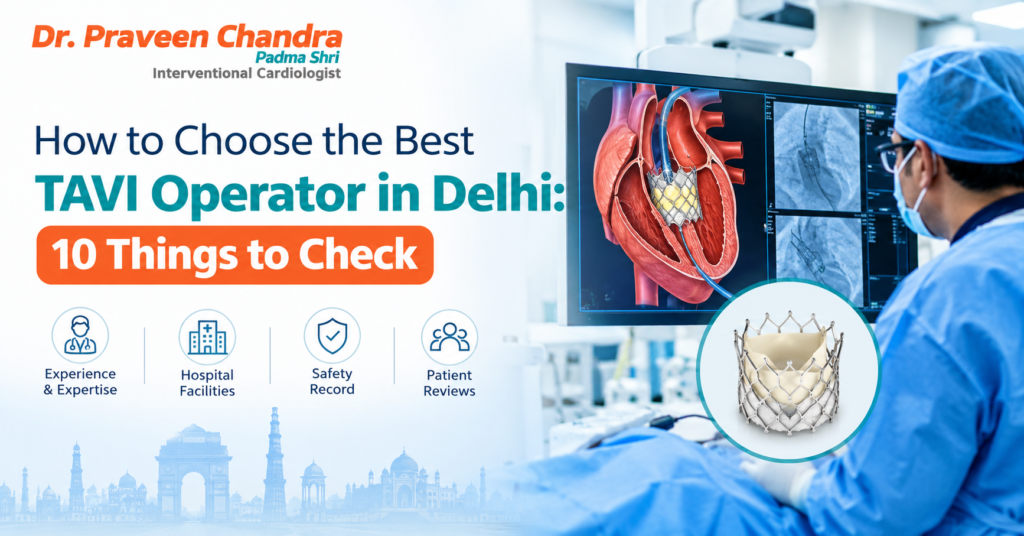
The selection of the doctor who is going to operate on your heart valve is a very significant matter if you plan to undergo Transcatheter Aortic Valve Implantation (TAVI). Patients and their family members may seek to find out The Best TAVI Operator or Surgeon in Delhi, but this matter requires much more than good visibility on the Internet and many credentials.
If you are a patient and researching the TAVI procedure under Dr. Praveen Chandra, it is important for you to ask the right questions and know how it would be performed for your specific case. The recent European guidelines stress heart team discussion, specialized valve centers, advanced imaging, patient preference, and an individualized approach to treatment. Here are 10 things that you need to verify while choosing a TAVI specialist in Delhi.
1. Check Specific Experience With TAVI
TAVI is a highly specialized surgery that needs more than just cardiologist training. While comparing various cardiologists, inquire about their experience in transcatheter valve operations and whether TAVI is a part of their routine work.
Experience must be taken into account, along with the complexity of the case to be treated, the available infrastructure within the hospital, and the qualifications of the whole team that provides care. This is emphasized in the 2025 ESC/EACTS guidelines on Heart Valve Centres and Heart Teams. In addition to asking, “Is the doctor experienced?”, ask more detailed questions regarding the doctor’s involvement with TAVI procedures and what types of cases he typically handles.
2. Look Beyond the Individual Doctor: Evaluate the Heart Team
TAVI is not just a single-surgeon technique. It may involve a multidisciplinary team of cardiologists, cardiac surgeons, radiologists, anaesthesiologists, and many others according to the patient’s requirements.
The team assesses the patient’s condition, test results, anatomy, risk factors, and treatment options, and then recommends an appropriate therapy. The current guidelines put considerable stress on this collaborative process.
Inquire whether the case will be presented by a team focused on the heart and whether both the TAVI and surgical approaches are considered where necessary.
3. Check the Hospital’s TAVI Infrastructure
The other factor that a competent operator should have is an appropriate clinical environment. Inquire about the cardiac facilities, catheterization lab, imaging, cardiac surgery support, and critical care services offered at the hospital.
It is necessary that the center is well equipped for the management of any complications that may occur. The earlier recommendation by the ESC had clearly stated that the procedure is done in institutions where cardiac surgery is available. The same trend prevails even in today’s recommendations, where the emphasis is on specialist Heart Valve Centers.
4. Understand How Your Aortic Valve Anatomy Will Be Assessed
Each patient has their own heart and vessel architecture. Before TAVI, a thorough evaluation is necessary to assess the anatomy of the aortic valve, aortic root, and vessels.
Pre-procedural assessment can include an echocardiogram, CT scan, and other cardiac procedures based on the patient’s health condition. The Heart Team uses these procedures to determine whether TAVI is appropriate and to plan the procedure.
Ask your doctor:
- What imaging tests need to be done before TAVI?
- What information is provided by your CT scan about the valve and the blood vessels?
- Do I have any anatomic features that make me unsuitable for transfemoral access?
When a doctor explains such issues clearly, you can get to know why a certain approach to treatment has been suggested.
5. Ask Whether TAVI Is Actually Suitable for You
Finding The Best TAVI Operator or Surgeon in Delhi doesn’t necessarily mean assuming that TAVI is the best option.
Factors influencing the decision of opting for TAVI, surgical aortic valve replacement, and others include among others age, longevity, medical history, physical make-up of the patient, surgical risks, patient preferences, and future possible interventions. As indicated by the 2025 ESC/EACTS guidelines, a personalized Heart Team decision is a major consideration in selecting the method of treatment.
Consultation would be better off taking into consideration your overall condition and not only advocating for one particular procedure.
6. Ask How Procedural Risks Will Be Managed
There is risk associated with any invasive heart procedure. Prior to having TAVI, it is necessary for patients to understand the risks associated with their particular case and how the centre plans to deal with them.
Consult your doctor for information on various aspects like vascular problems, bleeding problems, heart rhythm problems, valve problems, and chances of undergoing more treatment procedures. The level of risk involved is not the same for all individuals and depends on various factors.
The key here is not to be searching for some assurance that there will be no risks at all. Rather, it is important to know how your specific risks have been evaluated and addressed.
7. Review the Doctor’s Approach to Shared Decision-Making
Good consultation will ensure that you are able to understand the diagnosis, options for treatment, their possible benefits, risks, and other alternatives.
Patients need to have enough time to ask their questions. Patient preference is currently taken into consideration in Heart Team decision-making because treatment should take into account both scientific evidence and the individual patient.
Before deciding, consider the following questions:
- Why is TAVI being recommended?
- What other options do I have?
- What are the main complications for me?
- If TAVI is not recommended, what happens next?
- What should I do after that?
Clear communication can make a complicated treatment decision easier to understand.
8. Ask About the Hospital’s Experience and Outcome Monitoring
On assessing the TAVI unit, enquire as to whether there is maintenance of procedural logs and tracking of clinical results. This is important since TAVI is a process which requires coordinated skills of many specialists.
According to the 2025 ESC/EACTS guidelines, Heart Valve Centres are expected to aim for high volumes and good outcomes and for difficult cases to be referred to centres with experience.
It is justifiable to pose the question about whether the centre evaluates TAVI results, as well as how those results are assessed.
9. Understand What Happens After TAVI
While the decision you make must consider the day of surgery, recovery, drug administration, monitoring and follow-up are also key aspects of valve management.
You must ask about who will keep an eye on your health status after the operation, how often follow-ups will occur, what symptoms should send you to the doctor, and how your care will continue in the future in relation to your heart.
10. Choose a Specialist Who Communicates Clearly
Medical knowledge is essential; however, communication is equally vital. The TAVI procedure may be complicated by its medical language and the diagnosis reports. Patients should have confidence in their right to ask questions for clarification.
In the course of your appointment, you will need to check if the doctor gives you the rationale for the treatment that he/she suggests, talks about other options, and answers your questions. You should have sufficient data to be able to make up your mind.
Questions to Ask Before Choosing a TAVI Specialist
What to Check | Why It Matters |
TAVI-specific experience | Helps you understand the specialist’s relevant procedural background |
Heart Team | Supports multidisciplinary assessment |
Hospital infrastructure | Provides access to specialist cardiac services |
Imaging and CT assessment | Helps evaluate anatomy and plan the procedure |
Treatment alternatives | Ensures TAVI is considered in the context of other options |
Risk discussion | Helps you understand your individual procedural considerations |
Outcome monitoring | Provides information about the centre’s quality-improvement approach |
Follow-up care | Clarifies what happens after the procedure |
Communication | Helps you understand and participate in treatment decisions |
Individualized planning | Ensures the recommendation is based on your clinical situation |
Conclusion
Selection of the TAVI expert requires much more than finding out a famous name or reading general reviews on the Internet. While finding the Best TAVI Operator or Surgeon in Delhi, one should take into account a number of aspects that will be discussed below. Above all, consider whether the recommended treatment is tailored to your body, medical condition, and treatment objectives. According to current recommendations, the recommended treatment should be patient-specific and multidisciplinary in nature, not cookie-cutter.
If you wish to assess Dr. Praveen Chandra for TAVI treatment, then these questions will act as an easy checklist when meeting him to cross-check his credentials and expertise regarding the procedure.
Frequently Asked Questions About TAVI
1. What is TAVI?
TAVI stands for Transcatheter Aortic Valve Implantation. This is a minimally invasive technique to replace an abnormal aortic valve without undergoing open-heart surgery. In TAVI, a new valve is inserted via a catheter, usually through an access point in the groin region.
2. What should I consider while selecting a TAVI doctor in Delhi?
You need to consider the experience of the specialist in performing the TAVI procedure, the expertise of the Heart Team, hospital infrastructure, imaging facilities, approach to risk assessment, and follow-up after the procedure. It is also critical to know whether the TAVI procedure applies to your condition.
3. Is TAVI appropriate for all patients with aortic valve disease?
No. TAVI is not always an appropriate treatment modality for all patients, and the appropriateness is determined by various variables, including the status of the valve, anatomy of the heart, the age and history of the patient, etc.
4. What pre-TAVI tests are required?
Common evaluation procedures include an echocardiogram and other advanced imaging procedures such as CT scans. Other tests are recommended depending on the health of the patient.
5. What do I need to ask the TAVI specialist during consultation?
It is important to inquire about the reasons why the TAVI procedure is being suggested; the available alternatives; the risks involved for me; the experience of the specialist; the hospital facilities; and the recovery/follow up needs.