
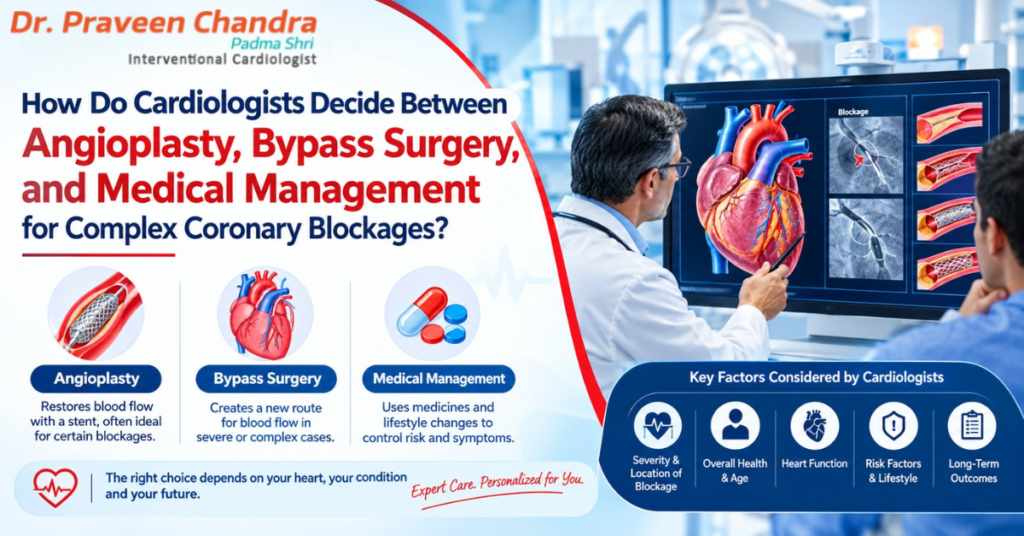
How Do Cardiologists Decide Between Angioplasty, Bypass Surgery, and Medical Management for Complex Coronary Blockages?
If a patient has been found to have coronary artery disease, the presence of a blockage does not always imply that he will need angioplasty or bypass surgery. The proper course of action will be determined by various elements such as the site of the blockage, its severity, the number of blocked arteries, the symptoms and the heart’s functions, among others.
For patients looking for the Best Cardiologist In Gurgaon, understanding how these treatment decisions are made can make consultations more productive and less confusing. Dr. Praveen Chandra approaches complex coronary disease within the broader principles of individualized assessment and evidence-based decision-making.
Cardiovascular treatment guidelines nowadays stress the importance of patient-centricity. In cases where the optimal approach to revascularization is not certain, a Heart Team may become engaged to take into account a range of factors including treatment alternatives and patient preferences.
What Makes a Coronary Blockage “Complex”?
All coronary obstructions are not alike in difficulty. First the cardiologist assesses the coronary anatomy and determines the extent of the disease.
Complex coronary disease can consist of:
- A number of significant obstructions in the major coronary arteries
- Disease of the left main coronary artery
- Protruding, extensive or highly calcified obstruction
- Several narrowed segments in one artery
- Anatomical challenges to the placement of a stent
- Significant disease of the branch arteries of a coronary artery
Complexity of the case of coronary artery disease will also play a role in determining which treatment modality (PCI [angioplasty + stent], CABG [bypass surgery], or medical management) is pursued. Tools such as the SYNTAX Score can also be used to determine anatomical complexity.
How the Best Cardiologist In Gurgaon Evaluates the Patient
The treatment method is not decided based on the angiogram alone. Normally, a cardiologist looks at the entire clinical presentation before suggesting any course of action.
1. Location and Severity of the Blockage
The location of the narrowing is important because certain coronary arteries are responsible for supplying regions that are larger or more vital parts of the heart muscle. In case of significant left main coronary artery disease, special consideration needs to be taken into account. It is stated that in such cases CABG is superior to PCI.
2. Number of Blocked Arteries
A simple obstruction can be ideal for angioplasty treatment, while multivessel involvement may call for a totally different solution.
In case of multivessel coronary disease, which is complex or diffused, some recommendations say that CABG could be more appropriate than PCI in specific cases.
3. Symptoms and Their Impact
Pain in the chest, difficulty breathing, poor exercise tolerance, and other similar symptoms could also affect treatment options.
In case where symptoms persist despite adequate medication, revascularization could be an option to consider. It should, however, be noted that assessment of symptoms is done in conjunction with coronary anatomy and general cardiovascular risk factors.
4. Heart Function and Other Health Conditions
Other factors that physicians also take into account are cardiac pump efficiency and comorbidities. Diabetes, kidney disease, prior history of heart surgery, age, and surgical risk factors can affect this equation of choice.
This is how two patients with apparently identical obstructions can get two divergent pieces of advice.
When Is Angioplasty Considered?
The procedure of angioplasty or PCI involves sending a catheter through the narrowed coronary artery. In this process, a balloon can be used for widening the narrowed space, and a stent is usually inserted.
This procedure can be performed when the anatomy of the coronary arteries is conducive and the benefits of the procedure outweigh the associated risks.
In particular, it can be relevant in situations where:
- Access and management through the use of the catheter is possible
- Anatomy of the coronary arteries allows performing stenting
- There is inadequate control of the symptoms despite medical therapy
- Revascularization procedure is justified from the clinical perspective
- PCI is a reasonable approach in the given anatomic case
However, the presence of a complex occlusion does not necessarily mean that angioplasty is indicated. The possibility of obtaining a stable result from a technical point of view is a crucial factor in deciding whether to proceed or not.
When Is Bypass Surgery Considered?
Coronary artery bypass surgery provides an alternative route for the flow of blood past the blocked segments of the coronary arteries. CABG might be recommended if the disease is widespread, especially if the anatomy renders PCI unsuitable for such patients. The guideline states that for patients with revascularization requirements, CABG should be preferred to PCI if the patient suffers from left main disease with high complexity coronary artery disease (CAD).
This decision also takes into account the ability of the patient to withstand the procedure and the balance between benefits and risks. Instead of merely posing the question “Which is better: bypass or angioplasty?”, cardiologists pose a more pertinent question of which procedure offers the best balance of efficacy, safety, and longevity?
When Can Medical Management Be Appropriate?
However, medical management is not necessarily “inaction.” It may also consist of therapy that helps to control symptoms and minimize cardiovascular risk. Such medical management will depend on the state of the patient’s health and may include:
- Cholesterol-lowering medications
- Medication for high blood pressure and other risk factors for heart disease
- Angina relief medication if needed
- Antiplatelet agents if necessary
- Stop smoking
- Exercise according to the individual’s ability
- Heart-healthy diet
- Controlling disorders such as diabetes
Management of chronic coronary artery disease includes the importance of lifestyle modifications and guideline-directed medical therapy.
In cases where there is no clear need for revascularization or the procedure does not have much clinical benefit to the patient, optimal medical management can serve the purpose.
How Cardiologists Compare the Three Treatment Options
Factor | Angioplasty (PCI) | Bypass Surgery (CABG) | Medical Management |
Treatment approach | Opens selected blocked arteries using a catheter | Creates alternate blood-flow routes around blockages | Uses medicines and lifestyle measures |
Best suited to | Anatomically suitable blockages | Selected complex or extensive disease | Patients where medication is appropriate |
Invasiveness | Minimally invasive procedure | Major surgical procedure | Non-procedural |
Key consideration | Technical feasibility of PCI | Surgical risk and coronary anatomy | Symptoms, risk factors, and overall disease profile |
Decision basis | Anatomy + symptoms + clinical factors | Anatomy + surgical risk + clinical factors | Overall risk + symptoms + treatment goals |
The Tabel Is a Simplified overview. In real-world practice, treatment decisions are individualized rather than based on a singel charaterstic
Why a Heart Team May Be Important for Complex Blockages
For certain heart cases, no solution is clear. In such circumstances, seeking advice from interventional cardiology as well as cardiac surgery will help one to compare PCI and CABG.
The ACC/AHA/SCAI revascularization guidelines recommend using a multidisciplinary team of cardiovascular specialists where the appropriate revascularization strategy is uncertain. The emphasis on shared decision-making means that the patient’s preference must be taken into account.
This approach can help patients understand:
- Why this therapy has been recommended
- Other alternative treatments available
- Risks involved in this procedure
- What medical treatment can accomplish
- In case of multiple reasonable options
When it comes to the best cardiologist in Gurgaon, in cases where the coronary disease has multiple solutions or is complex, a personal interaction can make all the difference.
What Should Patients Ask Before Choosing a Treatment?
Before undergoing an angioplasty, bypass surgery, or medical therapy, you should consult your cardiologist about:
- How many coronary arteries are affected to a great degree?
- Where are the blockages located?
- Is the disease complicated or diffuse?
- Am I a candidate for angioplasty from a technical standpoint?
- Why should I undergo bypass surgery?
- Can I be considered for medical therapy?
- What are the anticipated benefits and risks of each option?
- Can a discussion with the Heart Team be helpful?
- Will my additional health problems influence the decision?
- What will I have to do anyway?
Such questions will enable the patients to comprehend the reasons for such treatment and not only the procedure itself.
Conclusion
The selection of the most appropriate treatment of complicated coronary occlusions is not solely based on the degree of narrowing of the arteries shown in an angiography. It also depends on the location of the disease, its complexity, the number of vessels involved, symptoms, function of the heart, presence of other diseases, feasibility of the procedure, and the patient’s goal.
The guidelines aim at concentrating on the patient, as well as engaging the Heart Team where the best method of revascularization is unclear. Where patients wish to receive expert opinion about their complicated coronary conditions, Dr. Praveen Chandra can help to enlighten them about the different treatment options and key considerations in treatment selection.
Frequently Asked Questions
1. Why would a cardiologist select either angioplasty or bypass surgery?
The selection would depend on factors such as location of blockages, complexity of blockages, number of blocked arteries, functioning of the heart, comorbidity conditions, and whether the arteries of the heart are treatable using angioplasty.
2. Is there any type of coronary blockage that is unsuitable for angioplasty?
There are coronary blockages that cannot be effectively stented owing to some physical or anatomical conditions of the blockages.
3. When can medicine be used as an alternative to a procedure?
When medicine and lifestyle modification can control the symptoms and risk of complications effectively; or when the benefits of the procedure do not appear to outweigh the potential risk, medicine can be an alternative.
4. What is the role of the Heart Team in complex coronary disease?
The Heart Team usually consists of interventional cardiologists and cardiac surgeons among others. They evaluate difficult cases where the optimal approach for revascularization is not clear.
5. Is it possible for two individuals with comparable blockages to have different treatments?
Yes. The treatment is individualized and can be different because of differences in symptoms, cardiac function, age, co-morbidities, surgery risk, coronary anatomy, and patient preference.