
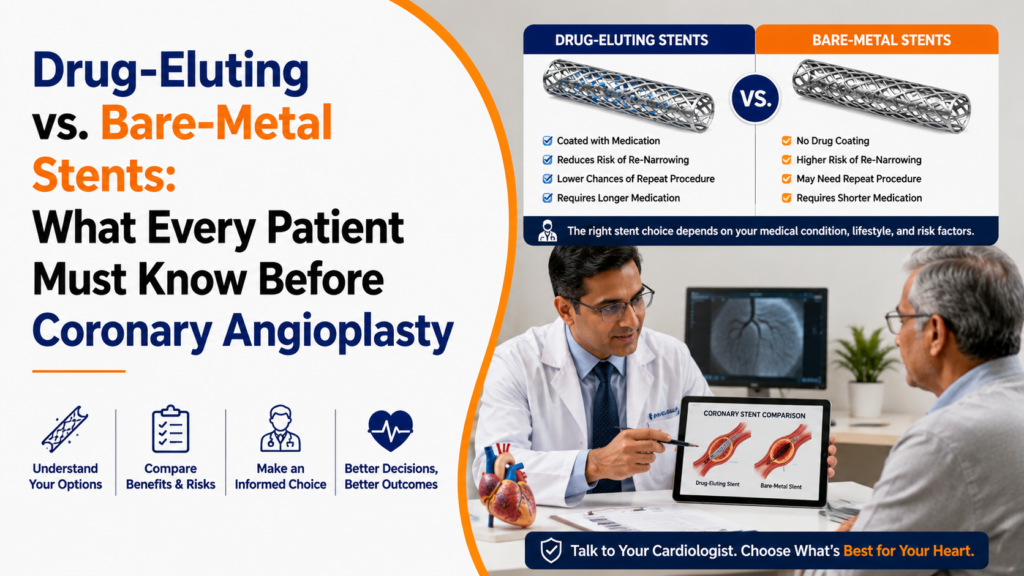
Drug-Eluting vs. Bare-Metal Stents: What Every Patient Must Know Before Coronary Angioplasty
By Dr. Praveen Chandra, Padma Shri, Chairman, Interventional Cardiology, Medanta – The Medicity, Gurugram
Patients preparing for coronary angioplasty are rarely handed a choice between stent types in any meaningful sense today. Yet, many still arrive at consultation having read, somewhere online, that one kind of stent is inherently superior to another. The honest answer is more interesting than a simple hierarchy, and understanding it equips a patient to ask better questions and to understand, with genuine clarity, what is actually being placed inside their artery.
The Evolution of Coronary Stenting
Coronary intervention began, in the late 1970s, with plain balloon angioplasty alone, effective in the moment but prone to leaving vessels to narrow again within months, a problem clinicians came to call restenosis. Bare-metal stents, introduced in the early 1990s, addressed part of this by providing a permanent metallic scaffold to hold the artery open after the balloon was withdrawn. Drug-eluting stents, arriving in the early 2000s, added a further refinement, a coating that releases medication into the vessel wall to suppress the biological overreaction that causes many stents to renarrow. Each step addressed a specific, well-documented failure mode of the one before it, which is what makes today’s stent landscape genuinely comprehensible rather than a matter of marketing.
Bare-Metal Stents: The Historical Baseline and Its Limits
A bare-metal stent is, in essence, a small mesh tube, typically stainless steel or a cobalt-chromium alloy, holding a coronary artery open through mechanical scaffolding alone, without any medicated coating. It does its immediate job well, restoring the vessel’s diameter and blood flow at the time of the procedure.
Its central limitation lies in what happens afterward. The body responds to any stent as a foreign object, and in the months that follow, vessel wall cells proliferate over and around the metal struts in a healing response called neointimal hyperplasia. In a bare-metal stent, this response is entirely unchecked, and in a meaningful proportion of patients, historically cited around twenty to thirty per cent depending on lesion complexity and vessel size, this excess tissue growth narrows the artery again, a phenomenon called in-stent restenosis, often requiring a repeat procedure.
Are bare-metal stents still used today? In modern practice, they have become a genuine rarity, reserved for narrow circumstances such as a documented severe allergy to drug-eluting stent polymer coatings, or a clinical situation demanding an unusually short antiplatelet course. For the overwhelming majority of patients, current guidelines and everyday practice favour drug-eluting stents as the default choice.
Drug-Eluting Stents: The Contemporary Standard, Explained Simply
A modern drug-eluting stent consists of three components working in concert: a thin-strut metallic scaffold, typically cobalt-chromium or platinum-chromium; a biocompatible polymer coating; and an antiproliferative drug, commonly everolimus, zotarolimus, or sirolimus, released gradually into the vessel wall over several weeks.
The purpose of this coating is precise rather than blunt. It does not prevent healing altogether, since some tissue coverage over the struts is necessary, allowing the vessel lining to re-establish itself normally, a process called endothelialisation. Instead, the drug moderates the excessive, disorganised cellular overgrowth that causes restenosis in bare-metal stents, allowing the artery to heal in a controlled, proportionate manner.
The technology has evolved meaningfully since its introduction. First-generation drug-eluting stents, using thicker struts, less biocompatible polymers, and the drug sirolimus or paclitaxel, achieved excellent reductions in restenosis but raised early concerns about a small increase in late stent thrombosis. Contemporary third and fourth-generation devices have addressed this directly, with markedly thinner struts, more biocompatible and sometimes biodegradable polymers, and refined drugs such as everolimus and zotarolimus offering a more favourable long-term safety profile. A stent placed today bears only a distant resemblance, in both design and outcome, to one placed two decades ago.
Head-to-Head: What the Evidence Actually Shows
The comparison between drug-eluting and bare-metal stents has been studied about as rigorously as any question in interventional cardiology, and the results deserve full honesty rather than selective emphasis. The Norwegian Coronary Stent Trial, the largest randomised comparison ever conducted, followed more than nine thousand patients for six years and found no significant difference between the two in the combined rate of death or non-fatal heart attack, a finding that surprised many in the field. Where the technologies diverged decisively was in the need for repeat procedures: patients with drug-eluting stents required significantly fewer repeat revascularisations than those with bare-metal stents, a difference that is, from a patient’s lived experience, considerable, representing the difference between one procedure and a strong likelihood of returning to the catheterisation lab within a few years.
| Feature | Bare-Metal Stent (BMS) | Modern Drug-Eluting Stent (DES) |
|---|---|---|
| Restenosis / repeat revascularisation | Historically around 20 to 30 percent | Generally below 5 to 10 percent in contemporary devices |
| Death or heart attack risk | Comparable to modern DES in large randomised trials | Comparable to modern BMS in large randomised trials |
| Stent thrombosis risk | Low, and similar to second-generation DES | Low with second and third-generation devices; early first-generation DES carried a modestly higher late-thrombosis signal |
| Required DAPT duration | Traditionally shorter, though modern guidance has narrowed this gap considerably | Minimum of 3 to 6 months for stable disease, 6 to 12 months for acute coronary syndrome, per current guidelines |
| Long-term vessel patency | Lower, due to unchecked neointimal growth | Higher, due to controlled healing response |
| Typical modern use case | Rare; specific allergy or bleeding-risk scenarios | Default choice for the large majority of patients |
Precision Diagnostics: Avoiding Unnecessary Stents
Because unnecessary intervention carries risk without corresponding benefit, contemporary interventional cardiology increasingly relies on physiological, rather than purely visual, evidence before recommending a stent at all. Fractional flow reserve and the related instantaneous wave-free ratio measure pressure differences across a blockage directly with a coronary pressure wire, distinguishing a narrowing that is genuinely restricting blood flow from one that merely looks significant on an angiogram. This distinction matters considerably, since research has consistently shown that stenting a blockage that is not functionally limiting flow offers little benefit over medical therapy alone, while treating one that is confirmed as flow-limiting meaningfully reduces the likelihood of a later urgent procedure.
Precision Deployment: Why the Specialist’s Technique Matters as Much as the Stent Itself
Selecting the right stent is only half of the clinical equation. The other half, arguably the more consequential half in determining long-term outcome, lies in how precisely that stent is deployed, and this is where a specialist’s technique, imaging discipline, and experience become directly relevant to a patient’s future.
Angiography alone provides a two-dimensional silhouette of a three-dimensional vessel, a view that can understate calcium burden, misjudge true vessel diameter, and miss an incompletely expanded stent or a small edge dissection. Intravascular imaging, using either intravascular ultrasound or optical coherence tomography, lets a cardiologist see the vessel wall from within, confirming correct sizing, full expansion, and complete apposition against the wall. Landmark research comparing the two approaches found that intravascular ultrasound guidance meaningfully lowered the risk of stent-related treatment failure compared with angiography alone, a benefit that grew more pronounced over years of follow-up and was strongest among patients whose procedures met imaging-defined criteria for a technically optimal result. This is a case where technology exists specifically to protect against human misjudgment, and its use in complex lesions reflects a real difference in procedural discipline between centres.
For heavily calcified arteries, where a stent cannot expand properly against an unyielding wall, rotational atherectomy and intravascular lithotripsy allow a specialist to modify that calcium safely before stenting. Bifurcation lesions and left main coronary disease similarly demand procedural planning, often imaging-supported throughout, that goes considerably beyond simply choosing a well-designed stent.
A Candid Note on Bioresorbable Scaffolds
Patients occasionally ask about bioresorbable vascular scaffolds, dissolving stents designed, in theory, to support the vessel temporarily and then disappear entirely, leaving no permanent implant behind. It would be less than fully honest to present this as an established, superior alternative available today. The first-generation bioresorbable scaffold to reach the market was withdrawn from worldwide sale in 2017 after large randomised trials showed a meaningfully higher rate of scaffold thrombosis compared with modern drug-eluting stents, particularly in the first three years after implantation. Newer-generation bioresorbable technologies remain under active research and development, and the concept itself remains scientifically compelling, but it has not, at this point, translated into a device that outperforms contemporary drug-eluting stents in real-world outcomes. Patients should treat this as a promising area of ongoing research rather than a currently available upgrade.
Understanding Dual Antiplatelet Therapy After a Drug-Eluting Stent
Every drug-eluting stent requires a period of dual antiplatelet therapy, typically aspirin combined with a second antiplatelet agent such as clopidogrel, ticagrelor, or prasugrel, to prevent clot formation on the device while the vessel wall heals around it. Current international guidance from the American College of Cardiology, the American Heart Association, and the European Society of Cardiology generally recommends a minimum of three to six months of dual therapy for patients with stable coronary disease, and six to twelve months for those treated after an acute coronary syndrome such as a heart attack, with the precise duration individualised according to a patient’s specific bleeding risk and ischaemic risk. Recent trials have shown that select patients, particularly those at elevated bleeding risk, can safely transition to single antiplatelet therapy earlier than the traditional twelve-month standard, a meaningful evolution in guidance that underscores why this decision should always be made in close consultation with the treating cardiologist rather than by a fixed, one-size-fits-all rule.
Choosing Dr. Praveen Chandra and India for Advanced Coronary Revascularisation
For patients weighing where to undergo angioplasty, whether a straightforward single-vessel procedure or a technically demanding case involving heavy calcification, bifurcation anatomy, or prior failed stenting elsewhere, the determining factor in long-term outcome is rarely the stent brand itself. It is the precision of the diagnostic workup beforehand and the discipline of the deployment technique during the procedure. Dr. Praveen Chandra, a Padma Shri awardee and Chairman of Interventional Cardiology at Medanta – The Medicity, Gurugram, has built a career around exactly this precision, with decades of experience across complex angioplasty, structural heart intervention, and high-risk percutaneous revascularisation.
Medanta’s infrastructure supports this discipline directly, with dedicated high-end cardiac catheterisation laboratories equipped for intravascular imaging and physiological assessment, hybrid operating suites, and round-the-clock dedicated cardiac critical care. Medanta holds accreditation from the Joint Commission International, alongside national NABH and NABL accreditation, reflecting adherence to internationally benchmarked standards of patient safety.
For international patients, this pathway typically begins with a virtual review: recent angiogram imaging or DICOM files can be submitted for a remote tele-consultation second opinion, allowing an initial, evidence-based assessment before any travel is arranged. From there, Medanta’s international patient services coordinate transparent treatment cost estimates, medical visa documentation support, and dedicated multilingual patient coordinators throughout the visit, so that a second opinion sought from abroad translates smoothly into coordinated, well-communicated care.
Frequently Asked Questions
Can a drug-eluting stent ever get blocked again?
Yes, though considerably less often than with a bare-metal stent. Modern drug-eluting stents carry restenosis rates generally below five to ten percent, compared with historical rates of twenty to thirty percent for bare-metal stents, and this risk is further reduced when the stent has been precisely sized and fully expanded using intravascular imaging at the time of implantation. Ongoing risk factor control, including cholesterol, blood pressure, and blood sugar management, along with prescribed antiplatelet therapy, remains important to sustaining this low risk over time.
What happens if I need emergency surgery while on blood thinners after a stent?
This situation requires careful, individualised coordination between the surgical team and the treating cardiologist, since stopping antiplatelet therapy prematurely carries a real risk of stent thrombosis, particularly in the weeks and months immediately following implantation. Current guidance generally recommends continuing aspirin through most surgical procedures where possible, while the second antiplatelet agent is paused and restarted as soon as safely feasible after surgery. Any patient facing unplanned surgery while on this therapy should ensure their surgical team communicates directly with their cardiologist before any medication is stopped.
Are drug-eluting stents safe for patients with diabetes?
Yes, and in fact drug-eluting stents are generally considered the preferred choice for patients with diabetes, who historically experienced higher rates of restenosis with bare-metal stents due to a more pronounced vessel healing response. Contemporary drug-eluting stents, supported by precise intravascular imaging during placement, have narrowed this outcome gap considerably, though patients with diabetes still warrant particularly close attention to lesion preparation and stent sizing given their generally more diffuse pattern of coronary disease.
How long do I need to stay in India after undergoing elective coronary stenting?
Most patients undergoing an uncomplicated elective angioplasty can expect a hospital stay of one to two days, with a period of local observation afterward before international travel is cleared, typically a matter of several days to about a week depending on the individual case and the treating cardiologist’s assessment. More complex procedures, particularly those involving high-risk anatomy or additional support devices, generally require a longer observation window. Precise timing should always be confirmed directly with the treating team based on the specific procedure performed.
The question of which stent is best rarely has a single, universal answer, because the honest answer depends on the patient, the anatomy, and the precision with which the procedure itself is performed. What contemporary evidence makes clear is that the device alone accounts for only part of the outcome. The remainder, often the larger remainder, rests on accurate physiological assessment, meticulous lesion preparation, and imaging-guided deployment, the less visible craftsmanship that separates a good result from merely an adequate one.
If you have a scheduled angioplasty, an existing stent recommendation you would like reviewed, or wish to discuss the right stent strategy for your specific anatomy, Dr. Praveen Chandra and the Interventional Cardiology team at Medanta, Gurugram, welcome the opportunity to review your case. International patients can begin with a tele-consultation second opinion by submitting recent angiogram or DICOM files, supported by our dedicated coordination team throughout evaluation, treatment, and recovery. Reach out to schedule your assessment.