
By Dr. Praveen Chandra, Padma Shri, Chairman, Interventional Cardiology, Medanta – The Medicity, Gurugram
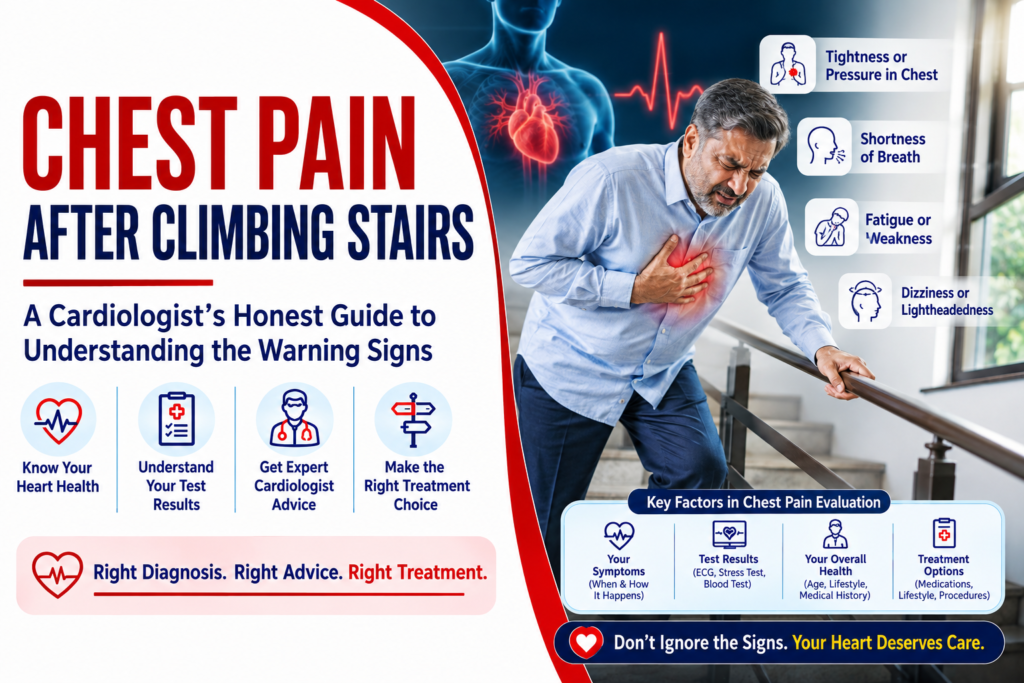
The staircase is one of the most quietly revealing tests in medicine, and almost no one recognises it as one. A patient climbs two flights, feels an unfamiliar tightness across the chest or a breathlessness that seems disproportionate to the effort, and reaches, almost reflexively, for the nearest explanation: poor stamina, too much coffee, a return to exercise after a long break, simply getting older. Very often, that explanation is correct. But a staircase is also, without any equipment or appointment required, one of the most efficient cardiovascular stress tests the human body ever performs on itself.
When coronary arteries carry a narrowing significant enough to limit blood flow under load, the staircase is frequently where that limitation first announces itself. Learning to recognise the difference between an ordinary bad day and the heart’s own warning signal is not about inviting anxiety into daily life. It is about knowing precisely when a sensation deserves a second look.
What Happens to the Heart Under Load
The heart muscle, like any working muscle, requires more oxygen-rich blood as demand increases, and under normal circumstances, healthy coronary arteries widen to meet that demand seamlessly, whether the trigger is a flight of stairs, a brisk walk, or a stressful meeting. When a coronary artery is narrowed by atherosclerotic plaque, this widening capacity becomes limited. At rest, the reduced but still adequate blood flow through a partially blocked artery may cause no symptoms whatsoever. Under the increased demand of physical exertion, however, that same narrowed artery cannot deliver enough oxygen to keep pace, and the resulting mismatch between the heart’s demand and the artery’s supply produces the sensation known as angina.
This is precisely why exertional chest discomfort follows such a distinctive, recognisable pattern: it appears reliably with a particular level of exertion, whether stairs, a brisk walk, or carrying groceries, and eases within minutes of stopping to rest, since rest immediately lowers the heart’s oxygen demand back within what the narrowed artery can supply.
According to the 2021 chest pain guideline jointly issued by the American Heart Association and the American College of Cardiology, the sensation itself is often not described by patients as pain at all, but as pressure, tightness, squeezing, heaviness, or a burning quality across the chest, sometimes extending to the shoulder, arm, neck, back, upper abdomen, or jaw. This is a meaningfully different sensation from a sharp, localised, pinprick-like pain that worsens with a specific movement or deep breath, a distinction that, while not diagnostic on its own, is often the first clue that separates a cardiac cause from a musculoskeletal one.
Red Flags That Demand Immediate Evaluation
Not all exertional discomfort carries the same urgency, and understanding the distinction between its different forms is genuinely useful, provided it is used to prompt timely evaluation rather than to self-diagnose and delay care.
Stable angina follows a consistent, predictable pattern: it appears at a reasonably reproducible level of exertion and resolves with rest, largely unchanged in character over weeks or months. Unstable angina represents a meaningful escalation, discomfort that now occurs with less exertion than before, arises at rest, lasts longer, or feels distinctly more severe than previous episodes. This escalation reflects a genuine change in the underlying coronary blockage and should prompt urgent medical evaluation rather than a wait-and-watch approach. An acute heart attack, in turn, involves a complete blockage of blood flow, producing severe, persistent discomfort that does not resolve with rest and constitutes a medical emergency requiring immediate care.
A further complication deserves particular emphasis, since it is frequently the reason serious disease goes unrecognised for too long. Chest discomfort is far from the only, or even the most reliable, sign of myocardial ischemia in every patient. Research reviewed in leading cardiology literature has shown that women, patients with diabetes, and older adults are considerably more likely to experience what specialists call anginal equivalents: unexplained breathlessness, unusual fatigue that does not improve with rest, nausea, cold sweats, or discomfort in the jaw, back, or upper abdomen, often without any prominent chest pain at all. In patients with diabetes, this pattern is compounded by nerve changes that can blunt the perception of pain itself, meaning that reduced blood flow to the heart may produce muted or entirely absent classic symptoms even as the underlying disease progresses. The clinical principle that follows is a simple but important one: the absence of textbook chest pain does not equal the absence of cardiac risk, particularly in these groups.
The critical triage rule, worth committing to memory, is this: discomfort that persists at rest, or that has become more frequent, more severe, or longer-lasting than before, has crossed from a pattern warranting evaluation into a pattern warranting emergency care.
Differentiating Cardiac Pain From Its Common Impostors
Chest discomfort has several everyday explanations that are considerably more common than coronary disease, and distinguishing between them by careful pattern recognition, while never a substitute for clinical evaluation, is a useful starting point.
Musculoskeletal chest pain, arising from the chest wall muscles or cartilage, is typically reproducible: pressing on the area, twisting the torso, or taking a deep breath tends to recreate or worsen it, and it is generally unrelated to exertion in the cardiovascular sense, though it may worsen with specific physical movements. Gastrointestinal discomfort, most often related to acid reflux, tends to have a burning quality, often relates to meals, worsens when lying down, and may improve with antacids, though it is worth noting candidly that reflux can also be triggered by the physical effort of climbing stairs or bending forward, which is precisely what makes self-diagnosis risky rather than reassuring. Respiratory causes, including asthma or other lung conditions, tend to centre around breathlessness and wheeze rather than chest pressure, though breathlessness alone, as discussed above, can also be a cardiac anginal equivalent in its own right.
The overlap between these categories, particularly between reflux and cardiac pain, both of which can be triggered by exertion and both of which can radiate similarly, is precisely why guessing is genuinely hazardous. No pattern-recognition exercise, however carefully reasoned, substitutes for objective clinical testing, and the appropriate response to genuine uncertainty is evaluation, not a personal diagnosis arrived at through trial and error.
The Modern Diagnostic Pathway: From Symptom to Certainty
Contemporary cardiology offers a structured, evidence-based pathway for resolving exactly this uncertainty, moving from simple, low-risk baseline tests toward more detailed evaluation only as needed.
The initial assessment typically begins with a resting electrocardiogram and a high-sensitivity troponin blood test, which the 2021 AHA/ACC chest pain guideline identifies as the preferred standard for detecting or excluding acute myocardial injury with considerably greater precision than older troponin assays. A 2D echocardiogram, an ultrasound of the heart, evaluates pumping function and valve structure and can reveal signs of prior, previously unrecognised ischemic injury.
Where baseline tests are inconclusive or symptoms suggest a functional limitation under exertion specifically, functional and anatomical stress testing follows. A treadmill test, or exercise ECG, recreates the physical demand of exertion under continuous monitoring, observing for the ECG changes and symptom patterns characteristic of ischemia. Stress echocardiography adds ultrasound imaging of the heart’s pumping motion under this same exertional load, often revealing regional wall motion abnormalities that a resting scan would miss entirely. CT coronary angiography provides detailed anatomical imaging of the coronary arteries themselves, useful for excluding significant blockage in patients with a lower likelihood of disease. When these tests indicate a meaningful probability of flow-limiting disease, a formal coronary angiogram, with fractional flow reserve measurement where appropriate to confirm the functional significance of any blockage found, remains the definitive diagnostic step, often performed in the same setting as any indicated treatment.
This structured pathway exists precisely so that a patient never has to rely on guesswork. Each step is chosen deliberately based on what the previous one has, and has not, revealed.
WHEN TO SEEK EMERGENCY CARE
• Chest discomfort that persists at rest and does not ease within a few minutes
• Pain, pressure, or tightness that has become more frequent, more severe, or longer-lasting than previous episodes
• Chest discomfort accompanied by cold sweats, nausea, vomiting, or lightheadedness
• Sudden breathlessness at rest, disproportionate to any exertion
• Discomfort radiating to the jaw, neck, back, or left arm, especially if new or severe
• Loss of consciousness or a fainting episode alongside chest discomfort
• Any chest symptom that feels distinctly different or more alarming than anything experienced beforeIf you or someone nearby experiences any of the above, seek emergency medical care immediately. Do not attempt to drive yourself, and do not wait to see if symptoms pass.
Why Consult Dr. Praveen Chandra in Gurgaon
For patients in Delhi NCR and those travelling from further afield to resolve genuine uncertainty about exertional symptoms, the value of a specialist consultation lies in exactly this discipline: an evaluation that neither dismisses a real symptom nor rushes toward unnecessary intervention. Dr. Praveen Chandra, a Padma Shri awardee and Chairman of Interventional Cardiology at Medanta – The Medicity, Gurugram, brings over three decades of experience in both preventive cardiac risk assessment and advanced interventional treatment, a combination particularly suited to patients presenting with exactly this kind of exertional ambiguity.
Medanta’s infrastructure is built to move a patient through this diagnostic pathway without unnecessary delay: rapid, multi-slice CT imaging, comprehensive non-invasive stress testing facilities, and a dedicated round-the-clock chest pain and cardiac emergency unit for patients whose presentation warrants urgent assessment. For regional patients across Delhi NCR, this typically means a same-visit pathway from initial consultation through baseline testing. For those travelling from further afield, including international patients, consultations can begin remotely, allowing an initial risk assessment and testing plan to be established before travel is arranged, followed by a coordinated, efficient evaluation once the patient arrives.
Frequently Asked Questions
Can acidity cause chest pain only when climbing stairs or walking fast?
It can, though this is precisely the scenario that makes self-diagnosis unreliable. Acid reflux can genuinely be triggered by the physical exertion and postural changes involved in climbing stairs or brisk walking, producing a burning discomfort that may resemble exertional angina. Because both conditions can present similarly under the same trigger, this overlap is best resolved through clinical evaluation rather than assumption, particularly if the discomfort is new, recurring, or accompanied by breathlessness.
If my pain stops as soon as I sit down, does it mean it was not a heart issue?
Not necessarily. Rapid relief with rest is actually a hallmark feature of classic exertional angina, since sitting down immediately reduces the heart’s oxygen demand back within what a narrowed artery can supply. This pattern, discomfort that reliably appears with exertion and reliably resolves with rest, is one of the more recognisable signatures of a cardiac cause, and should prompt evaluation rather than reassurance.
What is the first test a cardiologist runs for chest discomfort on exertion?
Evaluation typically begins with a resting electrocardiogram and, where appropriate, a high-sensitivity troponin blood test, alongside a clinical history and risk factor assessment. Depending on these initial findings, the cardiologist may then recommend a treadmill stress test, stress echocardiogram, or CT coronary angiography to clarify whether the coronary arteries are limiting blood flow under exertion.
How do I book a comprehensive cardiac screening in Gurgaon?
A comprehensive cardiac risk assessment can be scheduled directly with the Interventional Cardiology team at Medanta – The Medicity, Gurugram, beginning with a consultation to review symptoms, risk factors, and family history, followed by an individualised testing plan. International and out-of-town patients may begin this process remotely through a tele-consultation before travel is arranged.
The staircase will keep asking its quiet question of every person who climbs it, and for the overwhelming majority, the honest answer will remain what it has always been: simple deconditioning, a demanding week, nothing more. But for a smaller number, that same staircase offers an early, low-cost, entirely accessible signal, one worth taking seriously precisely because acting on it early is so much easier than acting on it late. Do not dismiss a genuine change in how your body responds to ordinary effort. Have it evaluated, and let the evidence, not the guesswork, tell you what it means.
If you have noticed chest discomfort, unusual breathlessness, or fatigue with exertion that concerns you, Dr. Praveen Chandra and the Interventional Cardiology team at Medanta, Gurugram, welcome the opportunity to help you find clarity. Regional patients across Delhi NCR can typically complete an initial consultation and baseline testing in a single visit. International and out-of-town patients may begin with a tele-consultation, supported by our dedicated coordination team throughout evaluation and, where needed, treatment. Reach out to schedule your cardiac risk assessment today.