
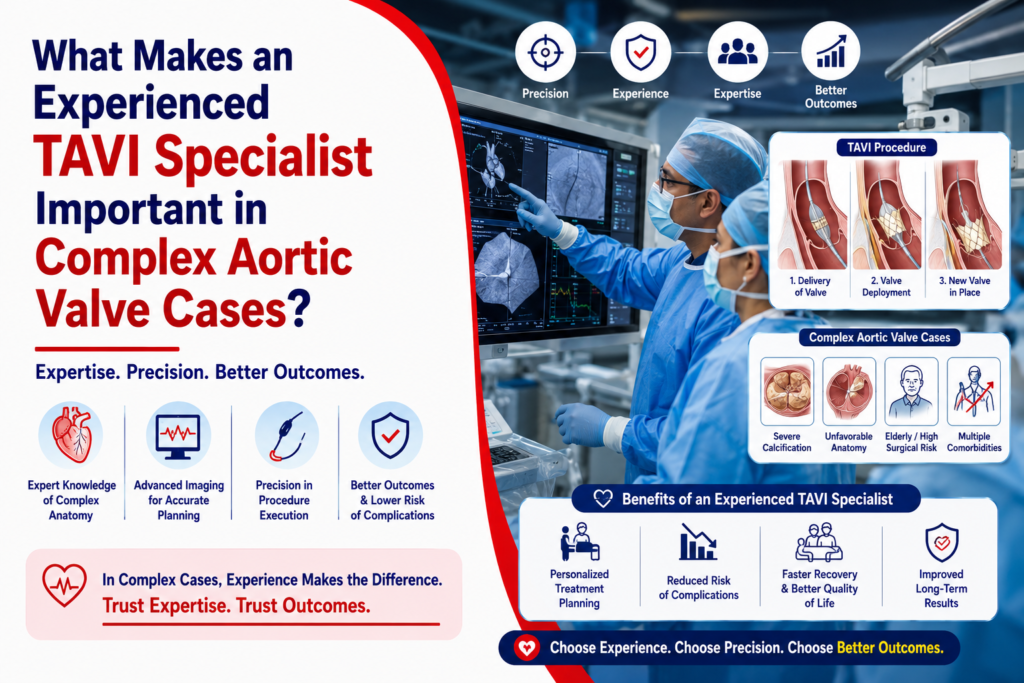
What Makes an Experienced TAVI Specialist Important in Complex Aortic Valve Cases?
Dr. Praveen Chandra
Chairman, Interventional & Structural Heart Cardiology, Medanta
Padma Shri (2016) | Performed India’s First TAVI | Pioneer of Structural Heart Intervention in India
Transcatheter aortic valve implantation represents a novel treatment for severe aortic stenosis. This treatment option used to require a complicated surgery and has become an option that allows treating the disease using a catheter approach without even opening the chest. Nonetheless, having moved from innovation to common practice, one thing has become obvious: the technique itself is only half the battle.
A TAVI procedure can hide the complexity under the veil of a minimally invasive treatment option. Each patient has a unique valve anatomy, unique pattern of calcification, unique valve-aortic structure, and a unique medical background. If the procedure looks rather easy for some patients, the experience of the treating doctor can be the decisive factor for another.
That is why the choice of a TAVI Treatment Specialist in Gurgaon should not be limited by the availability of this type of treatment itself. You need a professional who will be able to analyze your medical case in full, take into account the potential difficulties, and choose the proper valve.
Understanding Why TAVI Cases Can Be Complex
Severe aortic stenosis results when there is a narrowing of the aortic valve. This normally occurs due to thickening and heavy calcification of the valve leaflets. As the opening narrows, the heart must exert more effort to pump blood into the circulation of the body.
In the TAVI procedure, the prosthetic valve is implanted by delivery through a catheter, usually through the artery in the groin, into the patient’s diseased aortic valve. After implantation, the new valve will then perform the work of the original valve, enhancing the blood flow out of the heart.
However, the procedure is not only about the delivery of the valve at the predetermined site.
There are various structures that are found in proximity to the aortic valve. These include the coronary arteries, which arise just above the aortic valve; the conduction system, which lies near the valve; and the annular and aortic root sizes, which are very variable among patients.
Therefore, the first step in the successful TAVI procedure is the knowledge of the anatomy of these structures.
Experience Begins Before the Procedure
One of the most important aspects of TAVI is the assessment that takes place before the patient enters the catheterization laboratory.
A comprehensive evaluation usually includes echocardiography and detailed CT imaging of the aortic valve and surrounding structures. These images allow the Heart Team to assess the severity of stenosis, valve morphology, annular dimensions, coronary artery height, aortic root anatomy, vascular access, and the extent and distribution of calcification.
This information helps determine whether TAVI is appropriate and, if so, how it should be performed.
The choice of valve size and type is particularly important. A valve that is too small may result in residual leakage or inadequate function, while an oversized valve can increase the risk of annular injury or conduction abnormalities.
An experienced specialist does not look at these measurements in isolation. They interpret them in the context of the patient’s age, anatomy, symptoms, surgical risk, life expectancy, previous procedures, and long-term treatment goals.
The Importance of Patient Selection
Not every patient with severe aortic stenosis requires the same treatment.
For many years, surgical aortic valve replacement was the standard approach. The development of TAVI expanded treatment options, particularly for patients considered at high or prohibitive surgical risk. Over time, evidence from major clinical trials has demonstrated that TAVI can also be an appropriate option for selected patients at intermediate and lower surgical risk.
However, lower procedural risk does not mean that every patient should automatically undergo TAVI.
The decision should be individualized.
Age, anatomical suitability, life expectancy, existing coronary disease, bicuspid or tricuspid valve anatomy, vascular access, previous cardiac surgery, and the patient’s preferences all contribute to the final decision.
This is where specialist experience becomes particularly valuable. The right question is not simply, “Can TAVI be performed?” It is, “Is TAVI the best treatment for this particular patient?”
When Anatomy Makes TAVI More Challenging
Some cases require considerably greater planning than others.
Heavy or unevenly distributed valve calcification can affect valve deployment and increase the risk of complications. A bicuspid aortic valve, for example, can present anatomical challenges that require careful assessment of the valve shape, calcification pattern, annulus, and aortic root.
Low-lying coronary arteries create another concern. During valve implantation, displaced native valve tissue can potentially obstruct the coronary arteries. Careful pre-procedure imaging helps identify patients who may be at increased risk and allows the Heart Team to plan appropriate protective strategies.
Small or heavily diseased arteries can also complicate catheter access. Previous bypass surgery, abnormal aortic anatomy, severe peripheral arterial disease, or unusual vascular dimensions may require alternative access strategies or additional procedural planning.
These are situations where experience is not merely about performing more procedures. It is about recognizing potential problems before they become emergencies.
Precision During Valve Deployment
TAVI requires extraordinary precision.
The replacement valve must be positioned accurately within the native aortic valve. If it is positioned too high, too low, or not aligned appropriately, the patient may face increased risks of complications such as valve leakage, conduction disturbances, or interference with surrounding structures.
Modern TAVI systems provide sophisticated control and imaging capabilities, but technology does not replace clinical judgment.
The operator must continuously interpret fluoroscopic images, echocardiographic findings, haemodynamic information, and the patient’s anatomy to determine the ideal position for deployment.
In complex cases, even small adjustments can have significant consequences.
Managing Complications When They Occur
Most TAVI procedures are performed safely, but complications can occur.
These may include vascular injury, bleeding, stroke, annular rupture, coronary obstruction, valve embolization, significant paravalvular leak, or conduction abnormalities requiring a pacemaker.
The ability to manage these situations depends on more than the operator’s technical skills.
A mature structural heart programme requires rapid access to cardiac imaging, intensive cardiac care, vascular expertise, cardiac surgery when necessary, and a multidisciplinary Heart Team capable of responding immediately.
This is an important distinction when evaluating a TAVI centre. The expertise of the individual specialist matters, but so does the depth of the team supporting that specialist.
Why the Heart Team Matters
TAVI is fundamentally a multidisciplinary treatment.
Interventional cardiologists, cardiac surgeons, imaging specialists, anesthesiologists, cardiac intensivists, nurses, and other professionals may all contribute to the patient’s care.
The Heart Team reviews the patient’s clinical condition and imaging, evaluates different treatment approaches, and determines the safest strategy.
In complex cases, this collective decision-making can be particularly valuable because the best treatment may not always be obvious from a single scan or clinical measurement.
The purpose of the Heart Team is not simply to approve a procedure. It is to determine whether the procedure is appropriate, how it should be performed, and how the patient should be managed afterwards.
Experience and Long-Term Thinking
The success of TAVI should not be measured only by whether the valve was successfully implanted.
The ultimate objective is to give the patient a durable improvement in symptoms, heart function, independence, and quality of life.
That means considering what happens months and years after the procedure.
A specialist must think beyond the immediate technical result and consider valve durability, coronary access for potential future interventions, the likelihood of conduction problems, residual valve leakage, and the patient’s overall cardiovascular health.
This becomes especially important as TAVI increasingly reaches younger and lower-risk patients. A procedure that is technically successful today must also fit into the patient’s long-term cardiac journey.
TAVI Is Not a Procedure to Be Chosen by Technology Alone
One of the most important lessons in structural heart intervention is that newer does not automatically mean better for every patient.
TAVI has transformed aortic valve treatment, but surgical aortic valve replacement remains an important and highly effective option. In some patients, surgery may offer advantages based on age, anatomy, associated coronary disease, valve morphology, or the need for additional cardiac procedures.
The responsibility of an experienced specialist is therefore not to promote one procedure over another.
It is to understand when TAVI offers the greatest benefit—and when another approach may be more appropriate.
That distinction is at the heart of responsible interventional cardiology.
What Clinical Evidence Has Established
The role of TAVI has expanded considerably as clinical evidence has accumulated over the past two decades. Trials such as PARTNER and subsequent studies comparing transcatheter and surgical valve replacement have demonstrated that TAVI can provide excellent outcomes in appropriately selected patients across different surgical-risk categories.
But clinical trials also teach us something equally important: patient selection matters.
The results achieved in a carefully selected trial population cannot simply be applied to every individual with severe aortic stenosis. Anatomy, age, comorbidities, procedural risk, life expectancy, and expected quality of life all influence the treatment decision.
For this reason, expertise in TAVI is not measured solely by the number of valves implanted. It is reflected in the ability to interpret evidence and apply it appropriately to the patient sitting in front of you.
The Role of Advanced Imaging
Modern TAVI is fundamentally an imaging-guided procedure.
Echocardiography establishes the severity of aortic stenosis and provides information about ventricular function and other valve abnormalities. CT imaging provides the detailed anatomical roadmap required for procedural planning.
The CT scan can help determine annular dimensions, the shape and size of the aortic root, coronary artery height, calcium distribution, and the suitability of the vascular access route.
In complex cases, these details can change the entire procedural strategy.
A specialist who understands the relationship between imaging findings and procedural outcomes can anticipate challenges before the intervention begins. This is one of the reasons dedicated structural heart programmes place such emphasis on high-quality imaging and experienced interpretation.
When Previous Procedures Change the Equation
A patient’s previous cardiac history can make TAVI considerably more complex.
Someone who has previously undergone coronary artery bypass surgery, for example, may have a very different risk profile from a patient undergoing their first cardiac intervention. Previous valve procedures, existing pacemakers, peripheral vascular disease, or prior aortic interventions can also influence procedural planning.
Similarly, patients who have significant coronary artery disease may require careful consideration of coronary intervention alongside valve replacement.
An experienced Heart Team evaluates these factors together rather than treating the aortic valve in isolation.
The Importance of Managing the Unexpected
Even with meticulous preparation, medicine does not always follow the plan.
A valve may not behave exactly as anticipated during deployment. Vascular access may prove more challenging than imaging suggested. A patient’s blood pressure or heart rhythm may change unexpectedly.
This is where experience becomes particularly valuable.
An experienced TAVI specialist understands not only the standard sequence of the procedure but also the possible variations and rescue strategies. The ability to recognize a developing complication early can be just as important as technical precision during routine valve implantation.
This is also why a comprehensive structural heart centre should have appropriate emergency support readily available.
What Patients Should Look for in a TAVI Specialist
For a patient and family, assessing a specialist can feel difficult because procedural expertise is not something that can be judged simply from a consultation.
A useful starting point is to understand whether the specialist works within an established structural heart programme and whether treatment decisions are made through a multidisciplinary Heart Team.
It is also important to ask whether detailed pre-procedure imaging is routinely performed, how the team approaches complex anatomy, and what follow-up is provided after the procedure.
Perhaps most importantly, patients should feel comfortable asking a straightforward question:
“Why is TAVI the right treatment for me?”
A good specialist should be able to explain not only the advantages of TAVI but also its limitations and the circumstances in which surgery may be preferable.
TAVI in the Indian Setting
The growth of TAVI has been particularly significant in India, where the burden of degenerative valve disease is increasing alongside an ageing population.
For older patients who may have multiple medical conditions, avoiding the physiological stress of open-heart surgery can be an important advantage when TAVI is clinically appropriate.
At the same time, India presents a wide range of patient anatomies and clinical circumstances. Access to advanced imaging, experienced operators, appropriate valve technologies, cardiac intensive care, and multidisciplinary structural heart teams therefore becomes increasingly important.
The goal should never be simply to bring international technology to Indian patients. The real objective is to deliver that technology with the same emphasis on careful selection, procedural precision, safety, and long-term follow-up.
An Honest Word About Experience
Experience should never be reduced to a number.
Performing a large number of procedures is valuable, but experience also means knowing when not to proceed, when another treatment would be safer, and when a complex case requires additional planning.
TAVI has made a remarkable difference to patients with severe aortic stenosis, particularly those who previously had limited treatment options. But no procedure should be approached as a routine solution for every patient.
The strongest structural heart programmes combine technology with judgment. They use imaging to understand anatomy, evidence to guide treatment, and experience to manage uncertainty.
That combination is what allows minimally invasive valve replacement to deliver its greatest potential benefit.
Frequently Asked Questions
Is TAVI suitable for every patient with severe aortic stenosis?
No. TAVI is an important treatment option for many patients with severe aortic stenosis, but suitability depends on factors including age, symptoms, valve anatomy, surgical risk, life expectancy, vascular access, associated heart disease, and patient preference. The decision should be made by a multidisciplinary Heart Team.
Why is CT imaging important before TAVI?
CT provides detailed information about the aortic annulus, valve anatomy, calcium distribution, coronary artery position, aortic root, and vascular access. This information helps the team select the appropriate valve and plan the safest approach.
Is TAVI safer than open-heart surgery?
The answer depends on the individual patient. Clinical trials have shown TAVI to be an effective alternative to surgery in appropriately selected patients, but each treatment has its own advantages and risks. Age, anatomy, surgical risk, associated coronary disease, and long-term considerations all matter.
How long does a TAVI valve last?
Current evidence supports good durability of contemporary transcatheter valves, although durability remains an important consideration, particularly for younger patients. The expected lifespan of the valve and the possibility of future interventions should form part of the initial treatment discussion.
Does an experienced TAVI specialist make a difference?
Experience can be particularly valuable in complex cases because treatment involves more than valve deployment. Detailed imaging interpretation, appropriate valve selection, precise positioning, anticipation of complications, and coordinated management by a structural Heart Team all contribute to safe and effective care.
A Final Thought: The most important development in TAVI is not simply that we can replace an aortic valve without opening the chest. It is that we can now offer carefully selected patients a treatment pathway that was unimaginable a few decades ago. But innovation must always be accompanied by judgment. A complex aortic valve case demands more than sophisticated equipment. It demands careful imaging, thoughtful patient selection, technical precision, preparedness for complications, and a team capable of looking beyond the immediate procedure.
For someone searching for a TAVI Treatment Specialist in Gurgaon, the decision should therefore go beyond convenience or technology alone. The more important question is whether the specialist and the Heart Team have the expertise to determine what is safest and most appropriate for that particular patient. For the right patient, TAVI can transform the experience of living with severe aortic stenosis—from progressive breathlessness and declining mobility to renewed independence and improved quality of life. The technology is remarkable. But ultimately, it is the judgment behind the technology that matters most.