
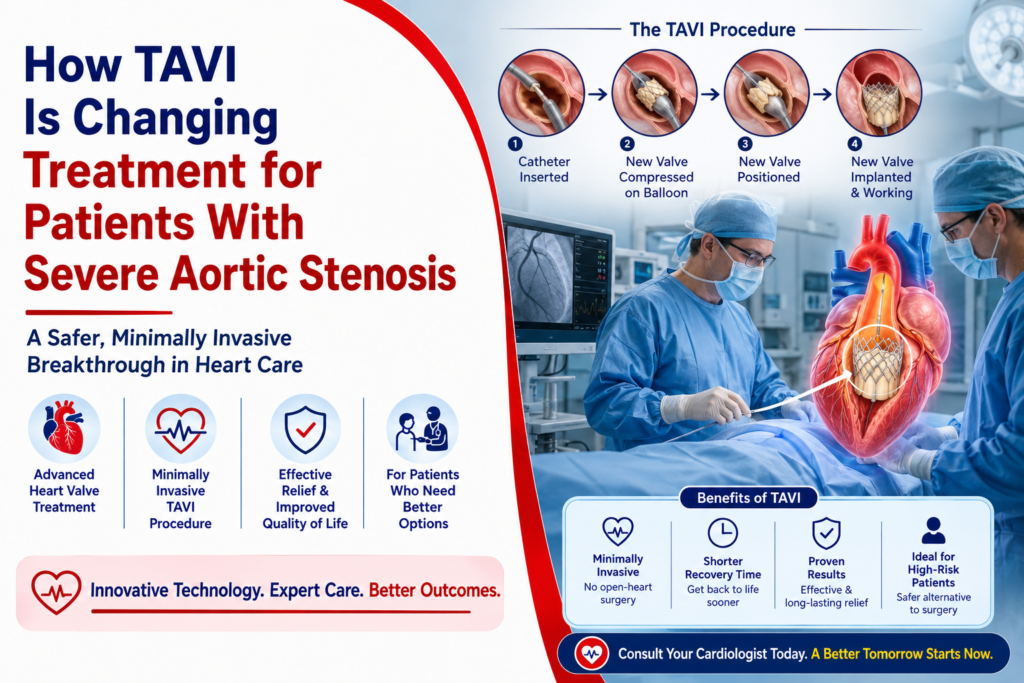
How TAVI Is Changing Treatment for Patients With Severe Aortic Stenosis
Dr. Praveen Chandra
Chairman, Interventional & Structural Heart Cardiology, Medanta
Padma Shri (2016) | Performed India’s First TAVI | Pioneer of Structural Heart Intervention in India
For many years, aortic stenosis was one of the hardest clinical problems to deal with, especially in the case of elderly people who suffered from other diseases and were considered too weak for an open-heart surgery procedure. The narrowing of the aortic valve causes less and less blood flow from the heart. This process affects the work of the heart muscles and limits a person’s physical activity.
The emergence of a new technique such as transcatheter aortic valve implantation or TAVI has revolutionized the entire field.
Originally intended for people who were unsuitable for surgical treatment, TAVI has evolved into a well-established approach for the treatment of properly selected patients regardless of their risk profile. The procedure implies that a new aortic valve can be placed using catheterization of arteries, usually from the leg artery, without the necessity to open the chest cavity.
However, the main significance of TAVI does not lie in the possibility of operating without open-heart surgery. What matters is the change in the approach to the treatment of the condition towards personalization, anatomy, minimal invasion, and a multidisciplinary approach.
Understanding Severe Aortic Stenosis
The aortic valve is situated between the left ventricle of the heart and the aorta, which is the main artery that carries oxygen-rich blood throughout the body. The valve opens every time the heart beats, allowing blood to leave the heart and closing again to prevent its backflow.
Aortic stenosis is a disease in which the valve narrows because of the calcification of the valve tissue. Besides, in elderly individuals, calcification may be an underlying cause of narrowing of the valve, while a bicuspid aortic valve, rheumatic heart disease, and other pathologies can result in the development of this disorder.
Due to the increased resistance, the heart needs to develop more pressure to force the blood through the narrowed passage. Ultimately, the left ventricle may be thickened and become weak due to excessive pressure.
The first sign is breathlessness during physical activities. Later, symptoms can occur with relatively modest activity. Chest discomfort, dizziness, fainting, fatigue, and reduced exercise capacity are other important warning signs.
Once severe symptomatic aortic stenosis develops, medical treatment alone cannot reverse the mechanical obstruction created by the diseased valve. Definitive valve replacement is generally required when intervention is appropriate.
From Surgical Replacement to TAVI
Surgical aortic valve replacement transformed the outlook for patients with severe aortic stenosis. By removing the diseased valve and replacing it with a prosthetic valve, surgery can effectively relieve the obstruction.
However, surgery requires an operation on the chest and the use of cardiopulmonary bypass. For an otherwise healthy individual, this may be an appropriate and highly effective treatment. For an elderly or medically fragile patient, however, the physiological burden of major surgery can be substantial.
TAVI introduced a different approach.
Instead of removing the native valve through open surgery, the replacement valve is compressed onto a catheter and delivered through the vascular system. Once positioned within the diseased aortic valve, it is expanded and takes over the valve’s function.
The native calcified leaflets are displaced outward, creating a new pathway for blood to leave the heart.
This relatively small change in how the valve is replaced has had a profound effect on patients who previously had limited treatment options.
How TAVI Has Changed Patient Care
The greatest transformation brought by TAVI is perhaps the shift away from viewing age or surgical risk in isolation.
Earlier generations of patients with severe aortic stenosis who were considered too high-risk for surgery might have received medications to manage symptoms, even though medicines could not remove the underlying valve obstruction.
TAVI created a treatment pathway for many of these patients.
Clinical trials initially established its role in patients at high or prohibitive surgical risk. Subsequent evidence expanded its use to selected intermediate- and lower-risk patients, although the choice between TAVI and surgery continues to depend on individual circumstances.
This evolution has made the treatment decision more nuanced.
Today, the question is not simply whether a patient is “fit enough” for an operation. The Heart Team considers the patient’s age, anatomy, life expectancy, surgical risk, associated cardiovascular disease, vascular access, valve morphology, expected durability, and personal preferences.
What Happens During TAVI?
TAVI is performed in a specialized cardiac catheterization laboratory or hybrid procedure room.
The procedure usually begins with vascular access through the femoral artery. A catheter carrying the compressed replacement valve is carefully advanced towards the heart under continuous imaging guidance.
Before deployment, the interventional cardiologist confirms the position and orientation of the valve relative to the native aortic valve and surrounding structures.
Once the correct position has been established, the replacement valve is expanded. The new valve immediately begins functioning, allowing blood to move more freely from the left ventricle into the aorta.
The entire procedure is performed with continuous monitoring of blood pressure, heart rhythm, oxygen levels, and cardiac function.
Compared with conventional surgery, the absence of a large chest incision can significantly reduce the physical burden of treatment and often allows patients to mobilize much sooner.
Why Patient Selection Remains Critical
TAVI is not a universal replacement for surgery.
A patient’s suitability must be established through detailed clinical and anatomical evaluation. Echocardiography confirms the severity of aortic stenosis and assesses ventricular function, while CT imaging provides an exceptionally detailed map of the aortic valve, annulus, aortic root, coronary arteries, and vascular access routes.
These measurements help determine whether TAVI is technically feasible and which valve size and type may be appropriate.
The anatomy of the coronary arteries is particularly important because the new valve must be positioned without compromising blood supply to the heart.
Similarly, the presence of extensive calcification, a bicuspid valve, small blood vessels, previous cardiac procedures, or other anatomical considerations can alter the treatment strategy.
This is why the expertise of the treating team remains essential even as TAVI technology becomes increasingly sophisticated.
The Role of the Heart Team
Modern TAVI is not a procedure that should be decided by one specialist working in isolation.
A dedicated Heart Team may include interventional cardiologists, cardiac surgeons, imaging specialists, anesthesiologists, cardiac intensivists, and other healthcare professionals.
Together, they assess whether TAVI, surgical valve replacement, or another strategy offers the most appropriate balance of benefit and risk.
This multidisciplinary approach is particularly important in patients whose clinical situation is complex.
For example, an older patient with severe aortic stenosis and significant coronary artery disease may require a different strategy from a younger patient with an otherwise healthy heart and a bicuspid valve. Similarly, a patient with previous bypass surgery or severe peripheral arterial disease may require specialized planning before a transcatheter approach is considered.
TAVI and Recovery
One of the reasons TAVI has been so transformative is the recovery experience.
Because the procedure generally avoids opening the chest, patients can often sit up and walk sooner than they would following conventional valve surgery. Hospital stays may also be shorter in appropriately selected patients.
The improvement in symptoms can be equally meaningful. Patients who previously became breathless after walking a short distance may find that everyday activities become easier after successful treatment. Some regain the ability to walk outdoors, climb stairs, or participate in activities they had gradually abandoned.
Of course, recovery differs from one patient to another. The presence of heart failure, kidney disease, lung disease, frailty, coronary artery disease, or other medical conditions can influence the pace of recovery.
The goal of TAVI is not simply to implant a valve successfully. It is to help the patient regain meaningful function and quality of life.
What the Evidence Has Taught Us About TAVI
The most important change brought by TAVI is not simply that a new device became available. It is that the evidence gradually showed us that selected patients with severe symptomatic aortic stenosis could achieve excellent outcomes without undergoing conventional open-heart valve replacement.
Early clinical trials established TAVI as an option for patients who were considered too high-risk for surgery. Subsequent studies expanded its role into intermediate- and lower-risk populations. Current clinical guidance therefore considers both TAVI and surgical aortic valve replacement (SAVR) in appropriate patients, with the decision based on anatomy, age, surgical risk, comorbidities, life expectancy, expected quality of life, and patient preferences.
Today, the question is more appropriately, “Which valve replacement strategy gives this individual patient the best balance of safety, durability, recovery, and long-term benefit?”
That is a much more meaningful question.
TAVI Is Not Simply a Less Invasive Version of Surgery
It is tempting to think of TAVI as simply the easier alternative to surgical valve replacement. Clinically, that is not quite accurate.
TAVI and SAVR are different procedures with different strengths and limitations. TAVI avoids opening the chest and, in many cases, allows a faster initial recovery. It can be particularly valuable in older patients, patients with significant medical conditions, or those in whom open surgery carries substantial risk.
At the same time, surgery may remain the better option for certain patients. A patient may have associated coronary artery disease that requires bypass surgery, an aortic condition that needs surgical correction, unfavourable vascular anatomy, a bicuspid aortic valve, or other anatomical considerations that change the balance between TAVI and surgery.
There are also important long-term considerations, including valve durability, the possibility of requiring a permanent pacemaker, and the risk of paravalvular leakage or future valve intervention.
This is why I would never describe TAVI as “better than surgery” in isolation. The right treatment is the one that is best for the particular patient sitting in front of us.
The Importance of CT and Detailed Imaging
Modern TAVI is an imaging-driven procedure. Before implantation, we need to understand much more than the fact that the aortic valve is severely narrowed.
A detailed CT assessment can help evaluate the dimensions and anatomy of the aortic root, the annulus, coronary artery relationships, and the vascular pathways through which the valve may be delivered.
This information helps the Heart Team determine whether transfemoral TAVI is feasible, which valve design and size may be appropriate, and how to reduce the risk of complications.
Echocardiography remains equally important because it establishes the severity of aortic stenosis, evaluates heart function, and helps determine whether the patient’s symptoms are actually related to the valve.
In difficult cases, the diagnosis itself may require careful interpretation. Low-flow, low-gradient aortic stenosis, for example, can present with apparently lower pressure gradients despite severe disease and requires a more comprehensive assessment.
This is where experience becomes important. A TAVI procedure does not begin when the catheter enters the artery. It begins with understanding the patient’s anatomy.
What About Patients Who Are Frail or Have Multiple Health Problems?
One of the reasons TAVI has been transformative is that many patients with severe aortic stenosis are elderly and have other health problems.
A patient may have kidney disease, diabetes, previous bypass surgery, lung disease, frailty, or a history of stroke. These factors can significantly change the risks associated with open surgery.
But frailty and age should not automatically mean that TAVI is appropriate either. The goal is not simply to perform a technically successful procedure. The goal is meaningful recovery.
If replacing the valve is unlikely to improve survival, symptoms, or quality of life because of severe non-cardiac illness or very limited life expectancy, intervention may not provide the benefit that the patient and family hope for. Contemporary guidance specifically emphasizes this concept of expected benefit and shared decision-making. That is an important conversation, and sometimes it is a difficult one. But honest medicine requires us to discuss not only what we can do, but also what is likely to help.
How TAVI Can Change Everyday Life
For the right patient, the difference after successful valve replacement can be substantial.
Breathlessness may improve. Walking may become easier. Simple activities such as climbing stairs, going to the market, or spending time with family may become possible again.
For someone who has gradually stopped doing these things because of breathlessness or fatigue, the improvement can feel much larger than a number on an echocardiogram.
Recovery is also generally quicker after an uncomplicated transfemoral TAVI than after open surgical valve replacement. Hospital stay may be relatively short, although the exact recovery period varies according to age, medical conditions, procedural complexity, and complications.
But improvement should never be promised as a guarantee. The heart may have been under pressure from a narrowed valve for years. Other conditions may also contribute to breathlessness or limited exercise capacity. TAVI treats the aortic valve. It does not erase every other cardiovascular or medical problem.
The Role of Experience in Complex TAVI
As TAVI has expanded, the procedure itself has become more sophisticated. The challenge today is not simply knowing how to implant a transcatheter valve.
It is knowing when TAVI is appropriate, which valve is suitable, how to interpret the imaging, how to anticipate complications, and how to manage unexpected situations when they arise.
There are patients with small annuli.
There are patients with extensive vascular disease.
There are patients with previous surgical valves.
There are patients with challenging coronary anatomy.
Some patients require careful consideration of future coronary access or potential valve-in-valve treatment.
These are not situations where a one-size-fits-all approach works. A TAVI Treatment Specialist in Gurgaon should therefore be evaluated not only by the availability of the technology, but also by the experience of the entire structural heart team, imaging expertise, surgical backup, and ability to manage complex cases.
TAVI is a team procedure. The interventional cardiologist, cardiac surgeon, imaging specialists, anaesthesia team, nurses, and other supporting professionals all contribute to the outcome.
Questions Patients and Families Often Ask
Is TAVI suitable for every patient with severe aortic stenosis?
No.
Severe aortic stenosis does not automatically mean that TAVI is the correct treatment. The decision depends on symptoms, valve anatomy, vascular access, surgical risk, age, associated conditions, expected benefit, and long-term considerations. A multidisciplinary Heart Team assessment is central to making this decision.
Is TAVI safer than open-heart surgery?
TAVI can offer important advantages in appropriately selected patients, including less invasive access and faster early recovery. However, it also has its own potential complications, including vascular complications, paravalvular leakage, and the possibility of requiring a permanent pacemaker. The balance of risks differs between patients.
Can an elderly patient undergo TAVI?
Age alone does not determine suitability.
In fact, TAVI has become particularly important for many older patients with symptomatic severe aortic stenosis. But overall health, frailty, anatomy, and expected benefit must be considered rather than age in isolation.
Does TAVI require open-heart surgery?
No. TAVI is a catheter-based valve replacement procedure. In the commonly used transfemoral approach, the replacement valve is delivered through the blood vessels, usually through an artery in the groin, and positioned inside the diseased aortic valve.
How long does recovery after TAVI take?
Recovery varies from patient to patient. Many patients have a relatively short initial hospital stay after an uncomplicated procedure, while full recovery can take longer depending on age, general health, and other medical conditions.
Is TAVI a permanent solution?
The implanted valve is designed to provide long-term function, but valve durability remains an important consideration, particularly in younger patients. The decision between TAVI and surgery therefore has to include not only immediate recovery but also the patient’s longer-term treatment pathway.

