
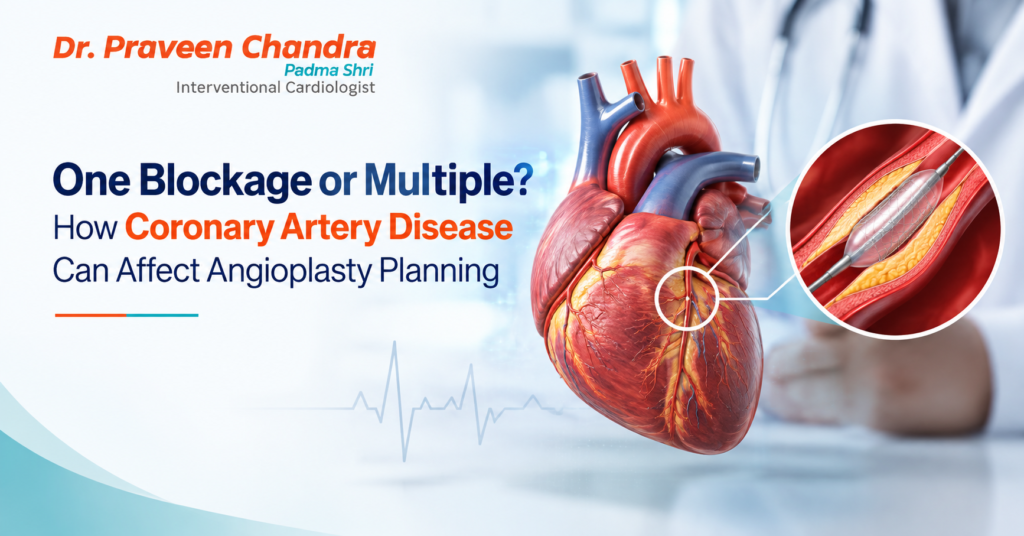
One Blockage or Multiple? How Coronary Artery Disease Can Affect Angioplasty Planning
Dr. Praveen Chandra
Chairman, Interventional & Structural Heart Cardiology, Medanta
Padma Shri (2016) | Performed India’s First TAVI | Pioneer of Structural Heart Intervention in India
When a coronary angiogram reveals a blockage, patients and families often ask a very direct question: “Can it be opened with angioplasty?”
The answer depends on much more than whether a blockage is present.
Coronary artery disease can involve one coronary artery, several arteries, and even multiple areas of the same coronary artery. There are some blockages that are short and relatively simple, while there are others that are long, severely calcified, near the point of bifurcation, and completely occluded. Even with two patients who have the same number of blockages, the treatment approaches for both would be entirely different.
For this reason, Coronary Angioplasty Treatment in Delhi NCR cannot be considered a standardized process wherein the steps taken in every case are more or less the same.
The goal here is not only to insert a stent anywhere there happens to be a narrowing. The goal is to restore blood flow in areas where it will help.
One Blockage Does Not Always Equal One Angioplasty
In a case involving only one coronary blockage, the situation may seem to be a simple case.
Yet even one lesion is capable of posing problems.
Where exactly is it? How long is it? How calcified is the vessel? Does it involve a major side branch? Is the vessel too small for the chosen stent? Is the disease really causing the symptoms?
These considerations are important.
For instance, a short disease process situated in a readily accessible portion of a coronary artery will probably be an easy case. A single lesion in a coronary artery situated in a bifurcation area, a prior stent site, or a severely calcified coronary artery is likely to be much more difficult.
This means that when reviewing a coronary angiogram, I do not simply tally up the lesions.
I focus on the anatomy involved.
What Changes When There Are Multiple Blockages?
Multiple blockages make the treatment decision more complex because coronary disease has to be considered as a whole.
A patient may have significant narrowing in the left anterior descending artery, another lesion in the right coronary artery, and additional disease in the circumflex artery. The next question is not automatically whether all three should receive stents.
We need to understand which lesions are clinically important and how much each one affects blood supply to the heart muscle.
The size and importance of the affected vessel matter. The severity and length of the disease matter. The presence of symptoms matters. Heart function matters. Diabetes, kidney disease, previous bypass surgery and other medical conditions also influence the treatment strategy.
In some patients, multiple lesions can be treated successfully with angioplasty.
In others, coronary artery bypass surgery may provide a more appropriate overall method of revascularisation.
This is why the number of blockages alone should never determine the treatment plan.
The Location of the Blockage Matters
Not all coronary arteries carry the same clinical significance.
A narrowing in a major proximal segment may have a very different impact from a narrowing in a smaller distal branch. Similarly, disease near an important bifurcation can create technical challenges because treating one branch must be planned without compromising another.
This becomes particularly important when disease affects the left main coronary artery or major proximal coronary vessels.
The angiogram therefore has to be interpreted anatomically rather than simply visually.
A patient may hear that they have “70% blockage” and immediately assume that the percentage alone determines whether a stent is required.
It does not.
The clinical importance of a lesion depends on its location, physiological significance, vessel size, symptoms, and the overall coronary anatomy.
Why a 70% Blockage Is Not the Whole Story
Percentage narrowing is useful, but it does not tell us everything about how a lesion behaves.
A coronary artery that looks significantly narrowed on angiography may not always produce the degree of blood-flow limitation that its appearance suggests. Conversely, a lesion that looks less dramatic may become important depending on its location and the amount of heart muscle it supplies.
This is where modern coronary intervention has moved beyond simply looking at an angiographic picture.
In selected patients, physiological assessment using techniques such as fractional flow reserve or instantaneous wave-free ratio can help determine whether an intermediate lesion is actually restricting blood flow sufficiently to justify intervention.
This approach helps answer a more meaningful question.
Not simply, “Does this artery look narrow?”
But, “Is this narrowing actually affecting blood flow enough that treating it is likely to benefit the patient?”
The Role of IVUS and OCT in Angioplasty Planning
There are situations where even a good angiogram does not provide enough information.
Intravascular ultrasound, or IVUS, allows us to examine the inside of the coronary artery and understand the vessel’s dimensions, plaque characteristics, and degree of calcification.
Optical coherence tomography, or OCT, can provide highly detailed images of the vessel and can be particularly useful in selected coronary interventions.
These technologies can help with decisions about stent diameter, stent length, lesion preparation, and final stent expansion.
This becomes especially valuable in complex disease.
For me, intravascular imaging is not about using technology simply because it is available. It is about using additional information when that information can improve procedural decision-making.
A stent that looks acceptable on an angiogram may still be inadequately expanded or positioned when examined from inside the vessel.
That is why imaging can be an important part of contemporary complex PCI.
When Calcium Changes the Entire Strategy
Severe coronary calcification is one of the situations that can significantly change angioplasty planning.
Calcium makes the artery rigid. A balloon may not expand properly against a heavily calcified lesion, and a stent may have difficulty crossing or expanding adequately.
In such cases, simply pushing a stent across the blockage is not necessarily the right approach.
The lesion may first need to be prepared.
Depending on the anatomy and severity of calcium, specialised techniques such as rotational atherectomy or intravascular lithotripsy may be considered.
These technologies are designed to modify calcium and make the vessel more suitable for balloon expansion and stent implantation.
The principle is simple, although the procedure itself can be technically demanding.
Before we can successfully treat the blockage, we sometimes have to prepare the artery to receive the treatment.
Why Long Blockages Require Careful Planning
A long coronary lesion can create a different set of challenges.
A longer area of disease may require a longer stent or more than one stent. This increases the importance of accurately defining the diseased segment and ensuring that the stent is properly expanded throughout its length.
The goal is to avoid leaving significant untreated disease at the edges while also avoiding unnecessary stent placement.
This is where detailed imaging and careful procedural planning become particularly valuable.
A technically successful angioplasty is not simply one in which the artery looks open at the end of the procedure.
We want to create an optimal result that is likely to remain beneficial over the long term.
What About a Completely Blocked Artery?
A chronic total occlusion, or CTO, is different from an ordinary narrowing.
Here, the artery is completely or almost completely obstructed, often with disease that has been present for a long time. The body may have developed alternative blood vessels called collaterals to supply the affected territory.
CTO intervention can require specialised equipment, detailed anatomical assessment and considerable operator experience.
The strategy may involve carefully navigating a guidewire through or around the occluded segment before restoring the vessel’s continuity.
Not every CTO needs to be opened.
The decision depends on symptoms, evidence of viable heart muscle, ischaemia, the anatomy and the expected benefit of successful revascularisation.
This is an important example of why coronary intervention should be patient-specific rather than procedure-driven.
Multiple Blockages and the Question of Complete Revascularisation
When several significant blockages are present, another question arises: should every important lesion be treated?
In some patients, complete revascularisation may be appropriate.
In others, treating the most clinically important lesions while managing other disease medically may be reasonable.
The answer depends on the clinical situation.
A patient presenting with an acute heart attack, for example, may require immediate treatment of the artery responsible for the infarction. The approach to other lesions may then be determined after the acute situation has stabilised.
In a patient with stable symptoms and complex multivessel disease, the decision may require much more detailed discussion.
This is where the Heart Team becomes important.
When Angioplasty May Not Be the First Choice
There are patients for whom coronary bypass surgery may be considered instead of PCI.
This can happen when the disease is extensive, involves important coronary segments, is anatomically complex, or occurs in a clinical setting where surgery may provide a more suitable overall revascularisation strategy.
Diabetes, reduced heart function and complex multivessel coronary disease can also influence this decision.
The important point is that angioplasty and bypass surgery should not be viewed as competing treatments where one is universally preferable.
They are different methods of restoring blood supply, and the appropriate choice depends on the individual patient’s anatomy and clinical circumstances.
What Patients Should Understand Before Angioplasty
If you or a family member has been told that there are one or several coronary blockages, the most useful question is not simply, “How many stents will be required?”
A better discussion begins with understanding the disease.
Which arteries are affected?
Which lesions are significant?
Are the symptoms coming from these blockages?
Is physiological assessment needed?
Would IVUS or OCT provide useful information?
Is the disease suitable for PCI?
Would bypass surgery be more appropriate?
What is the expected benefit of treating each lesion?
These are the questions that help turn an angiogram into an individualized treatment plan.
For anyone researching Coronary Angioplasty Treatment in Delhi NCR, this distinction is particularly important. Advanced coronary intervention is not defined by the number of stents placed. It is defined by how carefully the disease is assessed, how appropriately the treatment is selected, and how precisely the intervention is performed.
The Real Goal of Angioplasty
When we treat a coronary blockage, the final image showing an open artery is satisfying, but it is not the whole story.
The real goal is to improve blood flow to the heart, relieve symptoms when the blockage is responsible for them, and in appropriate clinical situations improve the patient’s cardiovascular outcome.
Sometimes that requires treating one blockage.
Sometimes several.
Sometimes the best decision is to leave a lesion untreated because it does not justify intervention.
And sometimes the coronary anatomy tells us that bypass surgery should be considered instead.
That is why good angioplasty planning begins with understanding the patient rather than counting the blockages.

