
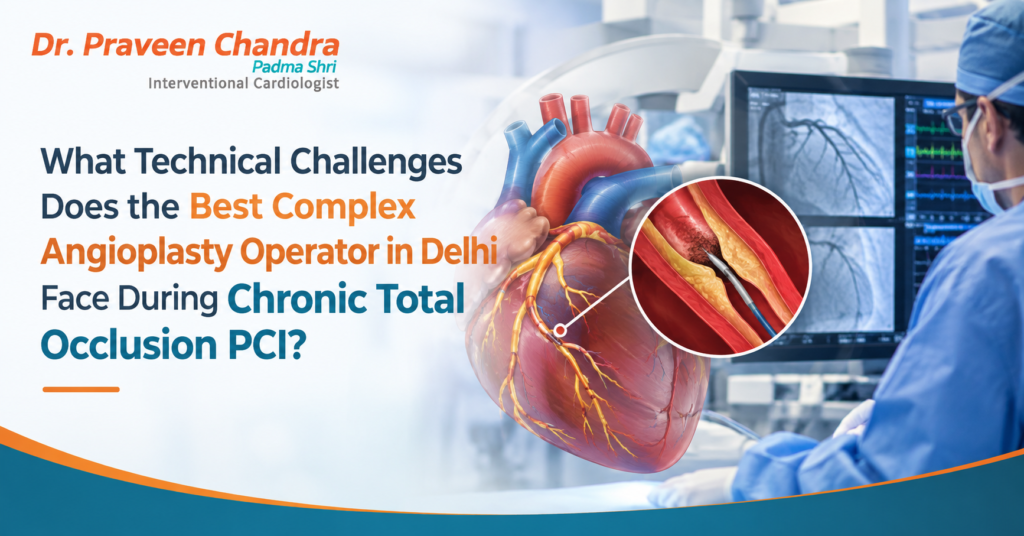
Percutaneous Coronary Intervention for Chronic Total Occlusion (CTO PCI) is among the coronary interventions that are relatively difficult. Unlike a typical coronary obstruction, CTO means that the coronary artery is blocked totally. Therefore, this procedure will involve detailed planning along with the use of particular equipment and guide wire manipulation. Furthermore, another level of difficulty comes from a difficult obstruction that can be long, highly calcified, and tortuous.
For those seeking the Best Complex Angioplasty Operator in Delhi, these considerations can help you understand the need for a tailored approach when performing these procedures. Dr. Praveen Chandra is an expert whom one can look into when considering complicated coronary procedures, but what should be considered is whether the treatment plan would suit the particular patient’s coronary system.
Why CTO PCI Requires Advanced Complex Angioplasty Skills
A chronic total occlusion may pose a problem regarding the crossing of the guidewire into the true lumen of the artery because of the occlusion present along the way. The first thing to do prior to performing the procedure is to determine where the occlusion lies and what kind of occlusion it is. Contemporary CTO guidance emphasises structured angiographic assessment and procedural planning. Factors such as an ambiguous proximal cap, calcification, vessel tortuosity, lesion length and the availability of suitable collateral vessels can influence the technical strategy.
The operator may begin with an antegrade approach, in which equipment is advanced from the normal direction of blood flow. If this does not provide a safe or effective route, dissection and re-entry or a retrograde approach may become necessary. This ability to change strategy is important because CTO PCI often involves several possible crossing techniques rather than one fixed method.
Best Complex Angioplasty Operator in Delhi: Managing Guidewire Crossing Challenges
One of the central technical difficulties in CTO PCI is guidewire crossing. A guidewire has to navigate through or around a complex occlusion while maintaining awareness of the vessel’s true architecture. Excessive force or inappropriate wire selection can increase the risk of entering an unintended space or causing vessel injury.
Operators may use different guidewires with varying characteristics depending on the anatomy and the stage of the procedure. A microcatheter is also important because it supports guidewire manipulation and allows wire exchanges during CTO procedures. Several situations can make wire crossing particularly difficult:
A poorly defined proximal cap
Long occlusion segments
Severe calcification
Significant vessel bends
Unclear distal vessel anatomy
Difficulty maintaining the guidewire within the intended vessel path
The challenge is not simply getting a wire across the blockage. The operator must also determine whether the wire is following the intended route and whether it has remained within the vessel architecture. Recent expert guidance on CTO PCI describes the importance of recognising abnormal guidewire behaviour during dissection techniques because an unexpected wire trajectory may indicate that the wire has exited the intended vessel structure.
Handling Long, Calcified and Tortuous CTO Lesions
Lesion characteristics can significantly affect the technical difficulty of CTO PCI, Long occlusions provide a greater distance for the operator to navigate. Severe calcification can make guidewire progression and subsequent balloon or device delivery more difficult. Tortuous vessels can also reduce the ability to control equipment precisely.
The J-CTO framework, for example, considers features such as calcification, bending within the occlusion, and lesion length when describing CTO complexity. Other CTO assessment systems also consider factors such as an ambiguous proximal cap and vessel tortuosity. In challenging anatomy, the operator may need to use additional support techniques. Guide catheter extensions can provide additional support during CTO recanalisation and may assist with antegrade dissection and re-entry or retrograde procedures.
The technical objective remains the same: cross the occlusion while maintaining adequate control of the equipment and minimising avoidable complications.
Best Complex Angioplasty Operator and Dissection-Reentry Techniques
When conventional antegrade wire escalation cannot cross a CTO effectively, dissection and re-entry techniques may be considered. These techniques involve intentionally creating a pathway outside the plaque or within a dissection plane and then returning to the true lumen beyond the occlusion. Contemporary expert consensus recognises dissection and re-entry as important techniques for CTO recanalisation, particularly in selected long or complex lesions. One technical challenge is controlling the size and direction of the dissection plane. A guidewire must advance in a controlled manner rather than unexpectedly leaving the intended vessel architecture.
Knuckle wire techniques are one example. Expert guidance describes different knuckle behaviours and emphasises careful recognition of wire movement. If the wire behaves unexpectedly or appears to leave the expected vessel boundaries, advancing additional equipment without reassessment can increase the risk of vessel injury. Re-entry is another important stage. Even after crossing the main occlusion, the operator still needs to establish a controlled connection with the distal true lumen. This requires careful assessment of the distal vessel and appropriate selection of the re-entry strategy.
Managing the Retrograde Approach and Collateral Channels
Some CTOs are difficult to approach from the proximal side. In selected cases, the operator may use a retrograde approach, advancing equipment through collateral channels from another coronary territory. This is technically demanding because collateral vessels may be small, tortuous, or difficult to navigate. The equipment must be advanced with careful control, and the operator needs to understand the anatomy before choosing an appropriate collateral route.
It can be combined with methods like reverse controlled antegrade and retrograde tracking. According to the retrograde wiring literature, the methods of antegrade wiring, antegrade dissection and re-entry, and retrograde wiring are all complementary to each other. In view of the added difficulties of retrograde techniques, case selection and preparation become more critical.
Using Intravascular Imaging During Complex PCI
Though angiography provides a two-dimensional image of the anatomy of the coronary arteries, there might be instances when a more complicated CTO procedure requires additional guidance. IVUS can give an inside look at the blood vessel through the artery and will be beneficial in decision-making in complex CTO procedures. It will be particularly useful in locating the lumen of the artery or when the relationship between the wires is difficult to discern from the angiogram.
Intracoronary imaging may also assist with lesion preparation and stent optimisation after the CTO has been crossed. Contemporary CTO recommendations emphasise meticulous lesion preparation and stenting, with intracoronary imaging often playing a role in complex procedures. The purpose is not simply to obtain additional images. Imaging can provide anatomical information that may help the operator make more informed technical decisions during the procedure.
Managing Complications During CTO PCI
An additional critical difficulty is the identification and management of any possible complications. Advanced CTO treatment approaches may have a number of hazards, including vessel perforation, dissection, or the formation of unintended tracts within the vessel structures. The expert agreement regarding the dissection approach, for example, emphasizes the necessity of recognizing any signs of the guidewire going out of the vessel through its behaviour.
Thus, it is crucial for complex PCI for the individual to be able to realise whether or not the particular strategy being used is safe. In some cases, the safest thing to do will be to switch crossing strategies, switch techniques altogether, or halt the procedure and reassess what needs to be done. Therefore, complex PCI involves not just knowledge about techniques, but judgement as well.
How Planning Influences Complex CTO PCI
Good preparation begins before the first guidewire enters the artery. A detailed review of angiographic images can help identify:
The proximal and distal caps of the CTO
Occlusion length
Calcification and vessel tortuosity
Distal vessel quality
Possible collateral channels
Potential antegrade and retrograde routes
The equipment and support required
CTO consensus literature highlights structured angiographic review, appropriate microcatheter use, and the ability to move efficiently between different crossing strategies as important elements of CTO PCI.
For patients, this also explains why the phrase Best Complex Angioplasty Operator In Delhi should not be understood simply as a title. When evaluating a specialist for a complex coronary procedure, patients can focus on relevant experience with CTO and complex PCI, the available procedural facilities, the approach to imaging, and how treatment options are assessed for their particular anatomy.
What Patients Should Discuss Before Complex CTO PCI
Patients considering CTO PCI should have a clear discussion with their cardiologist before the procedure. Useful questions may include:
What makes my coronary blockage a CTO?
How complex is the occlusion based on my angiogram?
What approach is being considered?
Could an antegrade, dissection-reentry, or retrograde technique be required?
Will intravascular imaging be useful in my case?
What are the potential risks and alternatives?
What happens if the initial crossing strategy does not work?
These questions can help patients understand that CTO PCI is an individualised procedure. The most appropriate technique depends on the patient’s anatomy, clinical circumstances, and the operator’s assessment.
Understanding Expertise in Complex CTO Procedures
Beyond navigating the blockage in a vessel lies the technical difficulty of CTO PCI. There are many aspects in this case, such as guidewire manipulation, lesion anatomy, collateral access, dissection and re-entry, intravascular imaging, and device support, among others.
If you are searching for the Best Complex Angioplasty Operator In Delhi, then the best place to start your research would be understanding the process itself and discussing the coronary anatomy with an interventionist cardiologist. Dr. Praveen Chandra can be considered as part of that research process, whereas the ultimate decision on the treatment would depend on the patient’s examination results, angiography, and consultations with the attending cardiac specialists.
Frequently Asked Questions
1. Explain CTO PCI?
CTO PCI is a procedure performed to open up a blocked coronary artery that has been occluded for a considerable amount of time.
2. What are some of the reasons for which CTO PCI may be challenging from a technical point of view?
The technique may become challenging due to various reasons such as long blockages, severe calcification, vessel tortuosity, unclear limits of the blockage, and complex coronary anatomy.
3. What are some of the techniques that may be used during CTO PCI?
Depending on the anatomy, an interventional cardiologist may apply antegrade wiring, dissection and re-entry procedures, and retrograde procedures using collateral vessels.
4. What is the purpose of intravascular imaging in complex PCI?
The use of techniques such as IVUS will allow obtaining detailed information regarding the vessel and may be useful for making decisions, preparing the lesion, and optimizing the stent.
5. Is CTO PCI appropriate for all patients having chronic blockages?
No, this is not necessarily the case. Suitability depends on various criteria.