
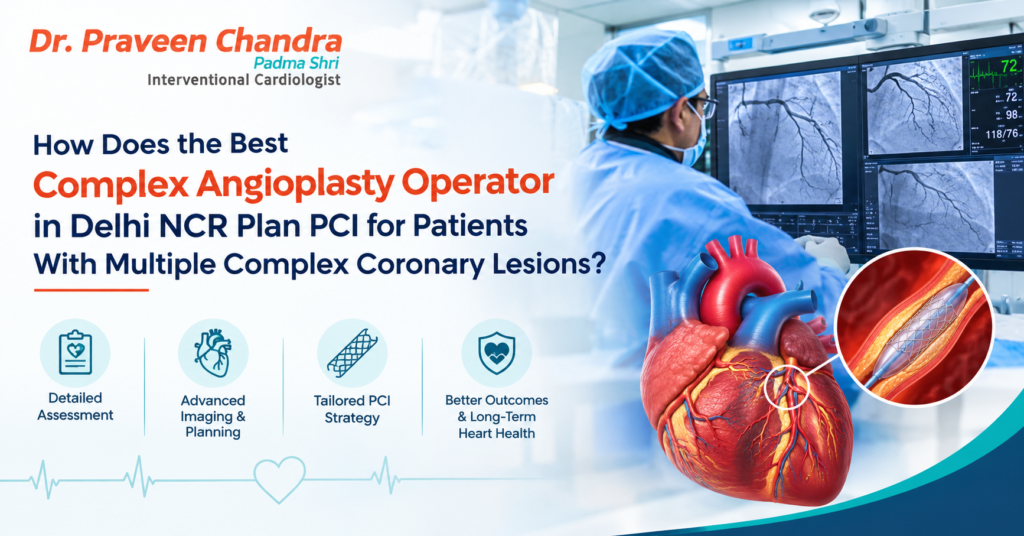
Some patients have a single blockage that can be stented in one straightforward procedure. Others have several blockages across different coronary arteries, some long, calcified, at a branching point, or in the main trunk of the heart’s blood supply. For these patients, the quality of the plan matters as much as the stenting itself. Those searching for the best complex angioplasty operator in Delhi NCR are usually trying to understand how such a plan is made.
This article explains how experienced operators approach PCI (percutaneous coronary intervention) when there are multiple complex lesions: how they decide whether PCI is right, which blockages to treat, in what order, and how they keep the patient safe.
Key takeaways
• The first question is not “how do we stent this?” but “is PCI, bypass surgery or medicine the best option for this patient?”
• Tests of blood flow and imaging help identify which blockages truly need treatment.
• Complex disease can be treated in one sitting or in stages, depending on safety and kidney function.
• A heart team often reviews complex cases, particularly with diabetes, left main disease or weak heart function.
What counts as “multiple complex coronary lesions”?
This usually means multi-vessel coronary artery disease (blockages in two or three of the heart’s main arteries) together with one or more difficult features, such as:
• Blockages in the left main coronary artery
• Long or heavily calcified lesions
• Blockages at branching points (bifurcations)
• A chronic total occlusion, an artery completely blocked for months
• Previous stents or bypass grafts that have narrowed
• Reduced heart pumping function, kidney disease or diabetes
The planning questions
Planning question | What the team considers |
Is PCI the right treatment at all? | Complexity of disease (such as the SYNTAX score), left main involvement, diabetes, heart pumping function, other illnesses and patient preference. Bypass surgery or medicines may be better in some patients. |
Which blockages are causing the problem? | Symptoms, stress tests, blood-flow measurements (such as FFR or iFR), imaging inside the artery and CT findings. |
Which lesion should be treated first? | Usually the lesion that supplies the most heart muscle or is most responsible for symptoms, balanced against how technically difficult each one is. |
One sitting or stages? | Total procedure time, contrast dye volume, radiation, kidney function and the patient’s stability. |
Is special preparation needed? | For heavily calcified lesions, tools to modify the calcium before stenting may be needed. |
Is extra support needed? | In very high-risk patients with weak hearts, a temporary pump support device may be considered. |
How will the result be checked and protected? | Imaging to confirm stent expansion, plus a plan for blood-thinning medicines and long-term risk control. |
How an experienced operator builds the plan
1. Mapping the disease
The planning starts with a coronary angiogram, and often a coronary CT scan. Together with an echocardiogram and the patient’s history, these show where the blockages are, how complex they are, and how much heart muscle is at risk. Scoring tools such as the SYNTAX score help rate the complexity of the disease on the angiogram.
2. Deciding between PCI, bypass surgery and medicines
For patients with multiple blockages, this is the most important decision. In general, bypass surgery is often favoured in people with extensive or very complex disease, especially when diabetes or weak heart function is present, while PCI is an option in many patients with less complex disease or when surgery carries high risk. Left main disease needs particular care, and PCI may be reasonable in selected patients depending on its complexity. These are general patterns, not rules. A heart team, including an interventional cardiologist and a cardiac surgeon, usually reviews complex cases together.
3. Finding which blockages matter
A blockage that looks tight on an angiogram does not always limit blood flow enough to need a stent. Pressure-wire measurements such as FFR or iFR, and imaging inside the artery such as IVUS or OCT, help decide which lesions need treatment. This can mean fewer stents and better-targeted care.
4. Setting the order of treatment
Operators generally treat the lesions that matter most first, which are the ones supplying the largest area of heart muscle or causing the symptoms. If a chronic total occlusion is part of the picture, the team decides when to attempt it, sometimes in a separate planned session.
5. One sitting or staged procedures?
Treating everything at once reduces the number of visits, but long procedures mean more contrast dye, radiation and strain on the kidneys and heart. Many complex patients are treated in stages, with a planned second procedure after a short interval. The choice depends on safety for that individual patient.
6. Preparing difficult lesions
Heavily calcified arteries may not open properly with a balloon and stent alone. Specialised tools can modify the calcium so the stent expands fully. The right tool depends on the lesion.
7. Stent strategy at branches and long lesions
At a branching point, a simple approach (stenting the main vessel and treating the side branch only if needed) works for many lesions, while more complex two-stent techniques are used selectively. In long lesions, careful stent sizing and complete expansion matter more than the number of stents.
8. Checking and protecting the result
After stenting, imaging can confirm that the stent is fully expanded and well-positioned. The patient then needs a clear plan for blood-thinning tablets (the duration depends on the situation), cholesterol and blood pressure treatment, diabetes control, and cardiac rehabilitation. Good long-term results depend on these as much as on the procedure itself.
Safety considerations in complex PCI
Kidney protection: limiting contrast dye and hydrating patients, particularly if kidney function is reduced.
• Heart function support: planning for support devices in very high-risk patients.
• Bleeding risk: choosing the blood-thinner plan according to the patient’s bleeding and clotting risk.
• Team readiness: access to cardiac surgery, intensive care and emergency equipment.
Questions to ask your angioplasty team
• Why do you recommend angioplasty rather than bypass surgery (or the reverse) for me?
• Which blockages need treatment, and which can be managed with medicines?
• Will you test blood flow or use imaging inside the artery before stenting?
• Will treatment be done in one sitting or in stages?
• How will my kidneys and heart function be protected?
• How long will I need blood-thinning medicines?
• Has my case been reviewed by a heart team?
About Dr. Praveen Chandra
Dr. Praveen Chandra is Chairman of Interventional Cardiology at Medanta Medicity, Gurgaon. He was awarded the Padma Shri by the President of India in 2016 and performed the first percutaneous aortic valve implantation without surgery in India. He has authored over 500 articles and is a reviewer for leading medical journals. His work includes structural heart interventions such as percutaneous tricuspid valve procedures and leadless pacemakers.
When should you see a cardiologist?
Consult a cardiologist promptly if you have chest pain or pressure on exertion, breathlessness, unusual tiredness, or if you have been told that more than one coronary artery is blocked. Seek emergency care immediately for severe or persistent chest pain, pain spreading to the arm or jaw, sudden breathlessness, or fainting.
Frequently asked questions
Can multiple blockages be treated in one angioplasty procedure?
Sometimes. Whether blockages are treated in a single sitting or in stages depends on how complex they are, how much contrast dye and procedure time are needed, your kidney function and your overall condition.
How do doctors decide between angioplasty and bypass surgery?
The decision depends on the number and complexity of blockages, whether the left main artery is involved, whether you have diabetes, how well your heart pumps, your overall health and your preferences. A heart team usually reviews complex cases together.
What is a SYNTAX score?
The SYNTAX score is a tool that rates how complex the blockages seen on an angiogram are. A higher score generally means more complex disease, and it helps guide the choice between angioplasty and bypass surgery.
Do all blockages need a stent?
No. Tests of blood flow and imaging help show which blockages are causing a problem. Blockages that are not significantly limiting blood flow are often treated with medicines and risk-factor control instead.
How do I book a consultation for multiple blockages?
You can book an appointment with Dr. Praveen Chandra’s team by calling +91 99588 72855 or +91 97172 89363.