
DIL SE BY DR. PRAVEEN CHANDRA
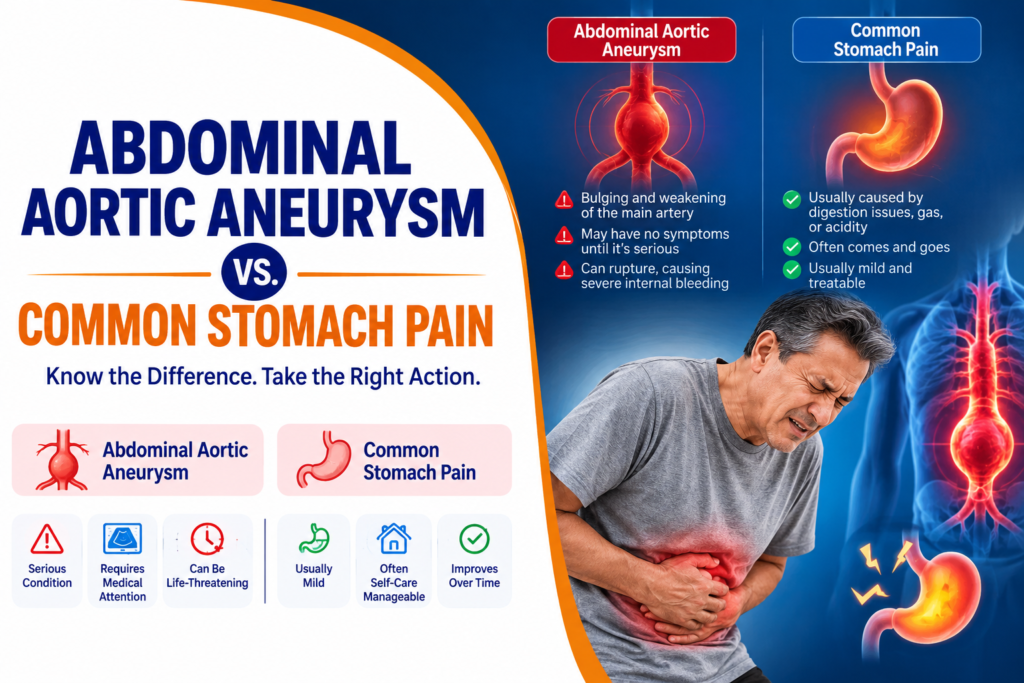
ABDOMINAL AORTIC ANEURYSM VS. COMMON STOMACH PAIN — What Should You Know?
By Dr Praveen Chandra, Padma Shri, Chairman, Interventional Cardiology, Medanta – The Medicity, Gurugram
Almost everyone has lived through a stomach ache that meant nothing: a heavy meal, a missed medication, a long flight, a stressful week. The body produces this kind of discomfort so routinely that most of us have learned, quite reasonably, to wait it out. But a small number of patients each year experience an abdominal ache that looks, in its opening moments, indistinguishable from all the others, and is in fact the first warning of an artery beginning to fail. Learning to tell the two apart is not an exercise in anxiety. It is a matter of knowing precisely when patience is wise, and when it is dangerous.
This distinction sits at the heart of one of the more difficult diagnostic questions in abdominal medicine, and it is worth examining with the same care and precision that the condition itself demands.
A Symptom Shared by Two Very Different Realities
Abdominal pain is among the most common reasons patients seek medical attention, and the overwhelming majority of cases trace back to entirely benign causes: gastritis, acid reflux, irritable bowel syndrome, constipation, or a simple muscle strain. An abdominal aortic aneurysm, a weakened, ballooning section of the body’s main artery as it passes through the abdomen, is, by comparison, a rare cause of abdominal discomfort. Yet its rarity is precisely what makes it dangerous, since both patients and, at times, clinicians may reasonably default to the far more common explanation.
There is a further complication worth stating plainly. According to research reviewed by Johns Hopkins Medicine, roughly three out of four abdominal aortic aneurysms cause no symptoms at all. They are frequently discovered only incidentally, during imaging performed for an entirely unrelated reason. This means that while learning to recognise the distinguishing features of aortic pain has real value, symptom vigilance alone can never substitute for risk-based screening in those who carry the relevant risk factors. The two approaches, symptom awareness and proactive screening, work in tandem, not in place of one another.
How Ordinary Stomach Pain Usually Behaves
Common abdominal pain tends to follow a recognisable rhythm. It often relates closely to eating, appearing after a particular food, a large meal, or on an empty stomach, and it frequently responds, at least partially, to antacids, a change in diet, or simple rest. The character of the discomfort is usually cramping, bloating, or sharp and fleeting rather than deep and constant, and it is often reproducible, meaning that pressing on the area, changing position, or passing gas may noticeably ease or worsen it. Crucially, this kind of pain rarely persists unchanged for more than a day or two, and it is not accompanied by any pulsing sensation.
How Aortic Pain Differs, When It Is Present
When an abdominal aortic aneurysm does produce symptoms, the pattern is notably different in character, even if the location can initially seem similar. Patients often describe a deep, gnawing ache in the mid to upper abdomen or lower back, one that persists regardless of meals, medication, or position, and does not meaningfully improve with rest. The pain may radiate outward toward the flank, the groin, or the legs, reflecting pressure on nearby nerves and structures as the aneurysm enlarges. Some patients notice a distinct pulsating sensation near the navel, a rhythmic beat that mirrors the heartbeat itself, a finding that warrants prompt clinical evaluation whenever it is present.
A sudden, severe escalation of pain in the abdomen or back, particularly when accompanied by dizziness, a rapid heartbeat, or cold and clammy skin, may indicate that the aneurysm is leaking or actively rupturing. This combination constitutes a medical emergency and calls for immediate emergency care, not observation or self-medication.
A Side-by-Side Comparison
The table below summarises the distinguishing features most useful in differentiating the two, though it is intended as a point of awareness rather than a substitute for clinical evaluation.
| Feature | Common Stomach Pain | Possible Aortic Aneurysm Pain |
|---|---|---|
| Relationship to meals | Often linked to eating, appears after specific foods or overeating | Unrelated to meals or digestion |
| Response to rest or position | Usually eases with rest, antacids, or a change in position | Persists regardless of rest or position |
| Character of the pain | Cramping, bloating, or sharp and fleeting | Deep, gnawing, and unrelenting ache |
| Pulsation | Not present | May feel a rhythmic pulse near the navel |
| Radiation of pain | Usually stays localised to the stomach or upper abdomen | May spread to the back, flank, groin, or legs |
| Duration | Resolves within hours to a couple of days | Persistent over days or sudden and severe without warning |
| Accompanying signs | Nausea, gas, or mild fatigue at most | Dizziness, rapid heartbeat, cold or clammy skin if rupture is imminent |
When to Seek Immediate Care
Certain presentations should never be observed at home, regardless of how ordinary the pain may initially seem. Sudden, severe abdominal or back pain unlike anything experienced before, particularly when paired with fainting, a racing heartbeat, or a sudden drop in blood pressure, warrants an immediate call for emergency medical help. This is especially true for individuals over the age of sixty-five, those with a history of smoking, and anyone with a first-degree relative previously diagnosed with an abdominal aortic aneurysm, since these factors meaningfully raise the likelihood that an alarming symptom reflects a genuine vascular emergency rather than a benign one.
Why Risk-Based Screening Remains the More Reliable Safeguard
Given how often this condition produces no warning at all, the more dependable strategy for at-risk individuals is not vigilant symptom-watching but a single, painless ultrasound screening, recommended internationally for men between sixty-five and seventy-five with any smoking history, and considered individually for others with relevant risk factors such as hypertension, atherosclerosis, or a family history of the condition. For patients in Gurgaon and those travelling from elsewhere in search of a trusted abdominal specialist for aneurysm care in Gurgaon, this is the conversation worth having proactively, well before any abdominal discomfort ever prompts it: a brief discussion with a cardiovascular specialist to determine whether screening is appropriate, long before the question becomes urgent.
A Closing Thought
Most abdominal pain will remain exactly what it appears to be: an ordinary, forgettable inconvenience. But the value of understanding this distinction lies not in worry, but in knowing precisely when patience is the right response and when it is not. That single piece of clarity, held quietly in reserve, is often what separates a story that ends in reassurance from one that does not.
If you are managing risk factors for abdominal aortic aneurysm, have a relevant family history, or wish to discuss whether screening is appropriate for you, Dr. Praveen Chandra and the cardiovascular and vascular team at Medanta, Gurugram, are available for consultation. International patients receive dedicated coordination throughout evaluation and treatment. Reach out to schedule an assessment and take a proactive step toward long-term vascular health.