
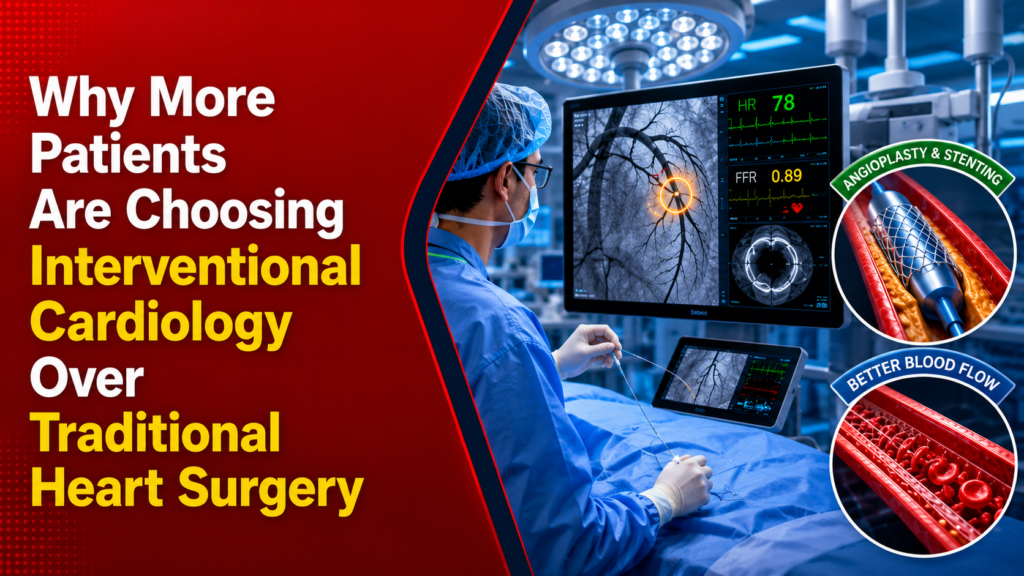
A generation ago, when I told a patient their aortic valve was failing, the conversation had only one inevitable destination: the operating theatre. There were no detours. Today, that same conversation has two paths, and more and more often, my patients and I choose the one that keeps the chest completely closed.
It is easy to assume this shift is just about choosing the easier road. But the truth is far more fascinating. What you are witnessing is the slow, deliberate verdict of two decades of global evidence, gathered across tens of thousands of patients. It is a story of how the balance of medicine tilted, and, with equal honesty, a look at where it has not.
What the Evidence Actually Showed
This shift didn’t happen on instinct. It was earned, milestone by milestone, through years of rigorous, head-to-head clinical trials that followed thousands of patients over decades.
The most definitive proof emerged from our approach to aortic valve stenosis, a condition where a severely narrowed heart valve restricts blood flow. Major global trials, specifically the PARTNER 3 and Evolut Low Risk studies, randomly assigned patients to either traditional open-heart surgery or a transcatheter, minimally invasive valve replacement.
The data was undeniable. In the first year, the catheter group fared markedly better, experiencing significantly fewer strokes, fewer hospital readmissions, and higher survival rates. Across five and then seven years of long-term follow-up, the two approaches drew completely level. Crucially, the advanced, minimally invasive valves showed no signs of wearing out faster than traditional surgical ones.
For a patient, the conclusion is profoundly clear. The gentler route is now fully equal to major surgery in the long run, and it is significantly kinder in the crucial early months of recovery.
We saw a similar breakthrough for leaking mitral valves in heart failure patients. The landmark COAPT trial proved that repairing the valve with a microscopic clip, combined with optimal medication, kept patients out of the hospital and added years to their lives compared to relying on medicine alone.
This is not experimental medicine; it is deeply scrutinised, peer-reviewed evidence. And it is the exact reason the conversation in my clinic has fundamentally changed.
Why a Patient Recovers Differently
Numbers aside, the true measure of innovation lives in the patient’s daily experience of healing. Open-heart surgery leaves an undeniable physical legacy; it requires dividing the breastbone, a profound trauma that takes months to knit back together. This skeletal healing becomes the long, exhausting focal point of recovery, anchoring patients to six to twelve weeks of strictly restricted living before they truly feel like themselves again.
A transcatheter procedure leaves only a small puncture at the wrist or the groin. Many patients sit up the same evening, return home within two or three days, and are back in their lives within a fortnight. For an older person, especially, avoiding a long anaesthetic and a major wound also means avoiding the confusion and the slow deconditioning that so often follow large operations in later life. For them, recovery becomes a genuinely different experience, gentler from the very first evening.
The Patients for Whom It Changed Everything
For one group, preference does not enter into it. The choice is between treatment and none. The very first transcatheter valves, in 2010, were given to patients whom every surgeon had turned away, people too old or too frail to survive an operation. Left untreated, around half of them would have died within two years. The catheter offered them, for the first time, a genuine chance.
I think often of the kind of patient this describes, the woman of eighty-four with a tight valve and tired lungs, breathless at her own front door, whom an earlier era would have sent home with sympathy and little else. Today, she comes into the hospital in the morning and, more often than not, leaves two days later with her breath restored. That, more than any single trial result, is what the change has meant.
Where Surgery Still Wins
I would be doing you a disservice and dishonouring fine colleagues if I left you believing surgery had been surpassed. It has not. For many patients, it remains the better answer, and I send them to the surgeon gladly.
A younger person who needs a valve is usually better served by an operation, because a surgical valve, or a mechanical one, can outlast the transcatheter kind across the decades they still have ahead. When the coronary arteries are blocked in many places at once, and especially in a patient with diabetes, the evidence from the FREEDOM trial is clear that a bypass operation protects them better than stents. For the most complex disease of the heart’s main vessels, surgery still holds the advantage. And a leaking mitral valve in a fit patient is most durably repaired by a surgeon’s hands. The art of modern cardiology lies in knowing these distinctions cold, and in wanting the right answer for the patient more than the satisfaction of providing it myself.
Why It Is No Longer a Contest
This is the deepest reason the question in the title is the wrong one to fear. In a good heart centre, the interventional cardiologist and the cardiac surgeon do not compete for the patient. They sit at the same table, study the same scans, and decide together. We call it the heart team, and it exists precisely so that no patient is steered toward the procedure their doctor happens to perform. The rise of the catheter has refined the question rather than diminished the surgeon, so that each patient receives the treatment the evidence supports for someone exactly like them. When this works as it should, the winner is always the person at the table.
So if you, or someone you love, is facing a decision about the heart, carry one idea with you. The goal is simply the right treatment for you, which may turn out to be the newest option or the most familiar one, and is always personal. Before you ever choose between surgery and a catheter, choose to be evaluated, fully and early, by a centre where surgeons and interventional cardiologists decide together. Bring your scans, bring your questions, and bring no fixed conclusion. The people who serve you best will be the ones willing to tell you the truth.
Dil Se,
Dr. Praveen Chandra