
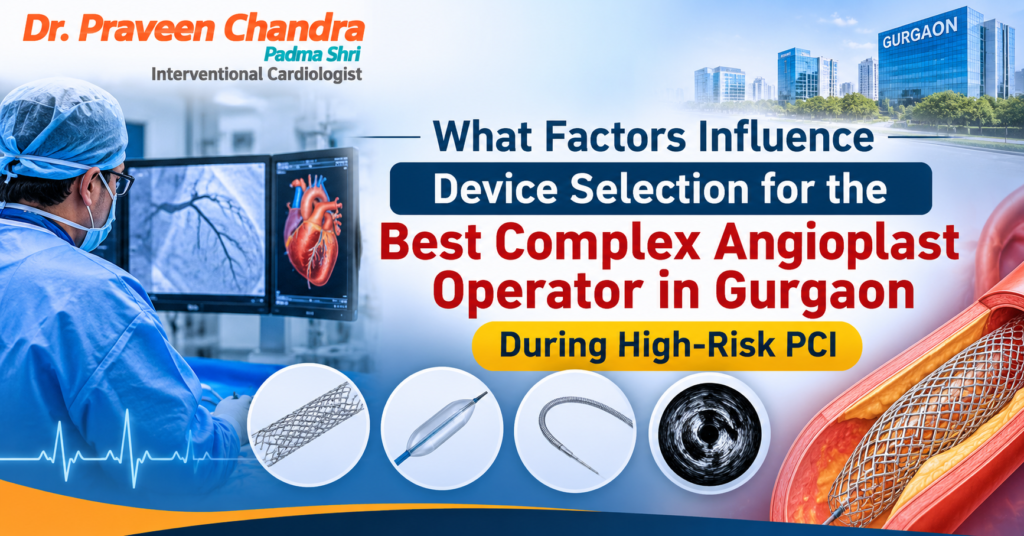
High-risk percutaneous coronary intervention is not easy to conduct and involves good planning and special medical devices. Where coronary arteries are significantly blocked, calcified, or have a complex structure, the choice of equipment is an integral part of the procedure. Those who look for the Best Complex Angioplast Operator in Gurgaon need to know that the choice of equipment is based on a number of clinical criteria, such as the place of the blockage, vessel size, heart function, and procedural risks. Another name one might look into when looking at the interventional cardiology options available for treating their coronary problems is Dr. Praveen Chandra. When doing high-risk PCI, the cardiologist will examine the patient’s coronary arteries, evaluate the results, and decide on what type of device he may need. This is done in order to devise an optimal treatment course, taking into consideration the patient’s safety and medical condition.
Understanding High-Risk PCI and Its Challenges
High-risk PCI is an approach used to restore blood flow in clogged or blocked coronary arteries. High-risk PCI should be considered when there exists a patient who suffers from complex coronary artery disease or when the patient has clogged arteries, poor heart function, or any other medical condition that increases the risk of performing PCI. Unlike simple angioplasty, complex PCI may require opening heavily calcified coronary arteries, long clogs, thin arteries, or lesions near the main coronary branches.
The selection of medical devices does not mean the selection of only one medical device called the stent. The operator should take into consideration the nature of the obstruction, the health state of the patient, and if it is necessary to use a special balloon, imaging tools, a device for removing plaque, and circulatory aid. Each patient has his/her own situation. The correct solution depends on diagnostic tests and the conclusions of the cardiologist.
Key Factors That Influence Device Selection for Complex Angioplasty Operator During High-Risk PCI
1. Location and Severity of Coronary Blockages
The placement and extent of the blocked area determine the equipment needed in the process of angioplasty. A lesion on a main coronary artery will need to be handled differently than an obstruction in a minor branched artery. The person performing the procedure will need to assess the length of the lesion, the amount of narrowing, the size of the vessel, and if the problem is occurring on more than one artery. Bifurcation lesions refer to lesions at or around the branching point of an artery.
In cases where there is a short lesion, balloon angioplasty can be done first, followed by placing the stent. For longer lesions, further preparation or the use of several stents will be needed. The aim is to choose devices that are appropriate for the anatomy and help treat the lesion without unnecessary risks.
2. Extent of Arterial Calcification
Calcium buildup makes the coronary arteries hard to open up. In instances where the lesion is quite calcified, the balloon will not be able to properly prepare the artery, and the stent will not expand as intended. The operator will have to consider the use of specialized tools designed to modify the lesions. Rotational atherectomy or intravascular lithotripsy, among others, can be used for this purpose.
These techniques function in different ways. Rotational atherectomy employs a specially designed rotating device to treat some types of calcified lesions, whereas intravascular lithotripsy involves using pressure waves to break the calcium within the wall of the blood vessel. The technique used depends on the localization and distribution of calcium, size of the vessel, equipment used, and operator experience. Proper preparation of the lesion can assist in delivering the stent to its target destination.
3. Vessel Diameter and Coronary Anatomy
Coronary vessels differ in size, form, and construction. The right choice of stent depending on the vessel size is important because an incorrect selection may cause trouble. The operator considers whether the vessel has a reduced lumen, tortuosity, or side branches that need to be preserved. Tortuous vessels are hard for the advancement of the devices inside them.
Catheters and guidewires are selected based on their function of providing support and providing required equipment to the targeted lesion. It is decided depending on both the anatomy of the lesion and the procedures intended to be performed. At times, intravascular imaging may be of great importance to provide information about size and plaque distribution.
How Advanced Imaging Supports Device Selection
Coronary angiography is an important diagnostic procedure that helps detect narrowed vessels and plan PCI. Yet, it offers only a two-dimensional image and does not reveal all details of the vessel wall or calcification. Sometimes, intravascular imaging helps to obtain additional information about the vessel. Intravascular ultrasound (IVUS) is an ultrasound technique that helps make images from inside the vessel. This procedure allows estimating the size of the vessel, plaque location, and stent expansion. Optical coherence tomography (OCT) is a method of obtaining high-resolution images of the coronary artery using light.
Both imaging modalities may help determine the right size, position, and expansion of the stent. Nonetheless, such an examination is not required for all patients. The cardiologist makes the decision to use either modality depending on the lesion, the patient’s health status, and procedural needs.
The Role of Circulatory Support Devices During High-Risk PCI
In other cases, the patient’s heart functions severely weakened, and he/she has a large extent of coronary disease, which can make it difficult to do complex PCI. In such cases, the operator considers whether it is time for temporary circulatory support. Depending on various conditions, the possibilities could be an intra-aortic balloon pump or a ventricular assist device. These types of devices vary by the way they work and the potential risks involved.
The choice hinges on a number of criteria, including patient cardiac function, the intricacy of the procedure, the general condition of the patient, and the risk of transient fluctuations in blood pressure or blood flow. The assistance of mechanical circulatory support is necessary in all high-risk PCIs. Nevertheless, its advantages should be balanced with possible risks of bleeding and vascular complications.
How Patient Health Affects Device Selection
The choice of device is dependent on the health status of the patient and the state of the coronary arteries. The medical history, kidney function, bleeding tendency, diabetes, and prior cardiac interventions could influence the treatment. It is especially important to consider kidney function, since PCI uses contrast dye to visualize coronary arteries. Impaired kidney function might require approaches to minimize contrast use.
The risk of bleeding will also affect the choice of access technique and antiplatelet drugs. Patients who have a poor functioning heart also need to be monitored carefully and plan the procedure accordingly. The operator then goes through the patient’s past angioplasties, stents, medications, and any other conditions. All this information will help the cardiologist determine possible complications and choose a suitable treatment plan. This is necessary because even patients with the same type of blockage can differ medically.
Why Operator Experience Matters in Complex Angioplasty
Equipment becomes an indispensable part of the complicated PCI procedure, but its importance depends upon proper selection and usage. The operator needs to know which special device he needs, how to use it, and what alternative options are available. While choosing the Best Complex Angioplasty Operator in Gurgaon, patients need to keep in mind that he has knowledge of complex angioplasty, advanced imaging, and the way he manages difficult anatomy.
Sometimes more complicated PCI requires changes to be made in the first plan if the artery reacts unexpectedly. It is very important for the operator to analyze the imaging findings, determine whether there were any problems with the working of the device, and decide on the need for further treatment. It is good for the patient to ask the specialist about his/her experience in the matter, about the planned procedure, etc.
Questions to Ask Before High-Risk PCI
Consultation is an important opportunity to learn the reasons behind the need for a procedure and the process through which the treatment program was established. The patients may ask:
Why is my CAD considered complicated or high risk?
Which instruments will be used, and for what reasons?
Will I need IVUS or OCT to be performed during the treatment?
Is there a need for temporary circulation support for me?
What are the potential advantages and disadvantages of the procedure?
What will be my post-procedure medical therapy?
This will help define the purpose of both devices and the rationale behind the treatment plan. It is important for patients to share any previous illnesses and medications that they take with their cardiologist as well.
Conclusion
The choice of device used in PCI for patients at high risk is contingent upon the coronary anatomy, the nature of the blockages, calcified arteries, artery size, cardiac function, and general well-being of the individual. The use of advanced imaging, specific plaque modification tools, and circulatory assistance devices may be useful in some patients, though they require individual evaluation. Proper planning assists in selecting the best method that will take into consideration the risks associated with the procedure. Patients seeking expert treatment for coronary complications may wish to contact Dr. Praveen Chandra. Consultation will make it easier to understand the treatment methods, devices used, and the pros and cons involved. The selection of the Best Complex Angioplast Operator in Gurgaon depends on clinical experience, the right technology, hospital facilities, and effective communication.
Frequently Asked Questions
1. Why is device choice affected when performing high-risk PCI?
The factors that determine device choice during high-risk PCI include blockage location and severity, vessel diameter, arterial calcification, coronary anatomy, heart function, as well as the patient’s medical history. Sometimes imaging results and the need for circulatory support may play an important role in choosing.
2. Why is intravascular imaging required during complex angioplasty?
IVUS and OCT allow visualisation of images of coronary arteries from inside. This may be used to assess vessel size, plaque characteristics, as well as stent expansion.
3. Is the use of specialised devices obligatory in all high-risk PCIs?
No. In some cases, regular angioplasty devices can be sufficient, whereas in other situations, specialised devices are required to address the issues related to heavy calcification or difficult anatomy.
4. Does heart functioning affect choice of device?
Patients with impaired heart functioning could have a hard time adjusting to temporary changes in blood flow and blood pressure that could result from PCI. The physician could assess the need for extra monitoring or temporary assistance due to the specific health status of the patient.
5. What criteria should people use when choosing a specialist for complex angioplasty in Gurgaon?
The most important criteria for choosing a specialist should be his/her experience in dealing with complex coronary angiography; the use of the latest diagnostic tools and medical devices; availability of proper facilities in the hospitals of Gurgaon.