
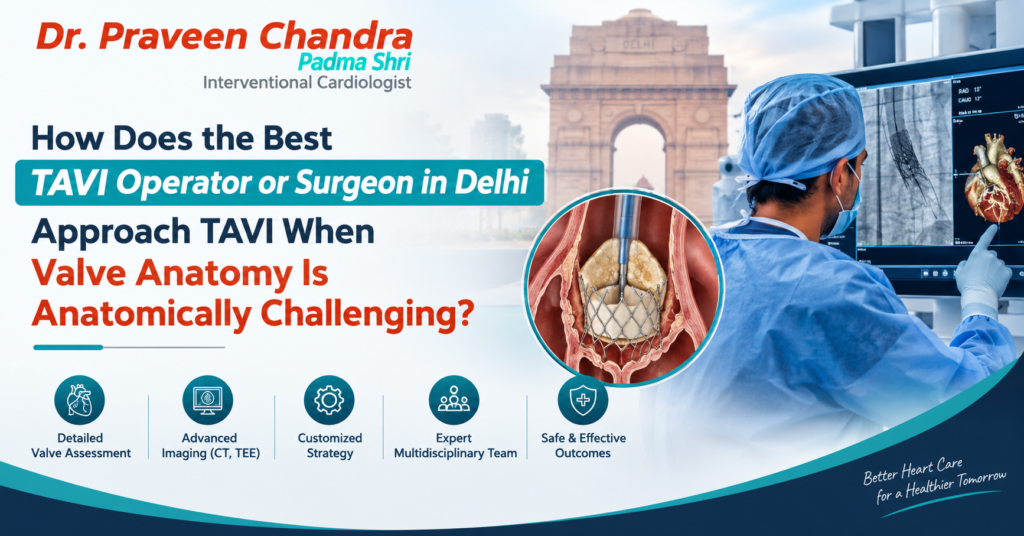
The Transcatheter Aortic Valve Implantation (TAVI) procedure is a minimally invasive method used in the treatment of severe aortic stenosis, a condition where there is narrowing of the aortic valve that results in the restriction of blood flow from the heart. Although the TAVI procedure can be an appropriate option for many patients, some patients are hard to treat due to various factors. The Best TAVI Operator or Surgeon in Delhi NCR requires one to know how such a specialist identifies the problems, chooses the right replacement valve, and performs the operation in accordance with the patient’s health.
Dr. Praveen Chandra is a name that might be considered when looking into specialist cardiac treatment and treatment options in case of complex heart valve disorders. It is important to know what specialists do with challenging TAVI procedures to be able to ask all the necessary questions.
What Makes TAVI Challenging in Patients With Complex Valve Anatomy?
The TAVI technique refers to the insertion of a new valve using a catheter through one of the vessels of the body, such as the groin. The new valve would then be positioned at the heart near the diseased aortic valve. Unlike the open-heart surgery technique, this one is done without an incision on the chest wall since the procedure does not open up the chest area. However, there might be some anatomical factors that affect the conduct of the TAVI method. These include:
High levels of calcium deposits: Calcium can have an effect on how evenly the replacement valve opens and seals against the tissues.
Bicuspid aortic valves: The bicuspid valves have two leaflets, instead of the three that normal ones have.
Small openings for the coronary arteries: The location of the coronary arteries may increase the chances of obstruction.
Small blood vessels: Narrow blood vessels can make the implantation of the valve challenging.
Abnormal aortic root measurements: This is because the aortic root measurements determine the valve placement and choice.
It does not imply that the problems make the TAVI procedure impossible. What it implies is that an assessment needs to be carried out to ascertain whether the procedure is appropriate and how the risks can be managed.
How the Best TAVI Operator or Surgeon in Delhi NCR Assesses Valve Anatomy
Knowledge about the structure of a patient’s heart is important prior to the TAVI procedure. The expert considers the level of stenosis in the aorta, the size of the valve, surrounding structures, as well as the patient’s general health state.
Detailed CT Scans and Echocardiography
Cardiac CT is one of the investigations essential in the planning ofthe TAVI procedure. This investigation gives detailed information about the aortic valve, aortic root, coronary ostia, and blood vessels that can be used in delivering the prosthetic valve. The size of the valve and risks of the procedure are determined using CT measurements. The distribution of calcium is also assessed using this investigation.
Further information is provided by echocardiography regarding the functioning of the valve, blood flow, difference in pressure across the valve, and the heart’s pumping ability. The specialist can then formulate a treatment strategy depending on the individual’s anatomy rather than using only the standard measurements.
Evaluating the Patient’s Overall Health
Anatomical evaluation is not the only aspect of TAVI evaluation. The cardiologist has to consider the condition of the kidneys, preexisting heart problems, frailty, previous heart interventions, and many other medical issues. Thus, patients with impaired renal system require particular attention if contrast-enhanced images are going to be taken. Patients who have a lot of calcium will have to undergo risk analysis for valve expansion.
How Valve Selection Helps Manage Complex TAVI Cases
The proper selection of a replacement valve is especially crucial when there is an unusual geometry of the native valve or significant calcification present. Various transcatheter valves have unique characteristics such as size, design, and mode of delivery. This is decided based on the patient’s anatomy, the presence of calcium deposition, and other considerations.
Managing Heavy Calcium Deposits
Calcification will make it hard for the new valve to expand evenly. This will impact the ability of the new valve to seal correctly with the surrounding tissues, thus increasing the chance that the patient might experience paravalvular leakages where blood passes through the valve. Calcification will also make it more likely for the structures around the implantation site to get damaged. This is why the specialist must assess the amount and pattern of calcification in order to select an appropriate valve and plan for its placement.
Treating Bicuspid Aortic Valve Anatomy
The bicuspid aortic valve presents yet another problem because its shape can be asymmetrical compared to a normal three-leaf valve. Any structural abnormalities in the aorta will also affect treatment strategy. Information obtained from CT imaging allows medical professionals to analyze the size of the valve, its calcium burden, as well as surrounding tissues. It will help them decide whether TAVI will be feasible and what type of replacement valve to use.
Not all patients suffering froma bicuspid valve can undergo the procedure. The patient’s suitability for TAVI must be assessed on an individual basis.
How the Best TAVI Operator or Surgeon in Delhi NCR Plans Accurate Valve Placement
Proper placement of the valve is crucial in ensuring proper functioning of the valve. This is especially true when the anatomy is complicated, as thorough planning is required to ensure that the valve is placed properly.
Reducing the Risk of Coronary Artery Obstruction
One of the complications in some patients undergoing TAVI is that of coronary artery occlusion. This happens due to the obstruction of blood flow into a coronary artery by the artificial valve or any tissue from the original valve. In terms of risk evaluation, some of the things looked at include the height of the coronary artery, aorta root size, and the location of the leaflets of the native valve. In case of high risks indicated in the imaging, there could be other measures considered to protect against the risk or even other treatment methods chosen.
Preventing Valve Leakage
The new valve should create a proper seal within the structure of the valve. Inadequate calcium deposits or improper fit could be a reason for leakage through the implanted valve. Proper valve choice, its correct placement, and evaluation of the result are ways to solve this problem. The valve is tested for its function during and after the operation in order to detect any leakage.
Considering these possibilities in advance will help the team to prepare for the challenges revealed during imaging.
What If the Usual Access Route Is Not Suitable?
In most cases, the TAVI procedure is done via the femoral artery. But there are situations where the patient has a narrow, heavily calcified, or tortuous artery that cannot allow for the delivery system. Here, the decision is made regarding whether there is a need to use another access point or not. The choice needs to be carefully evaluated since just because there is another way does not mean that it is better or safer. The specialist should take into account the vascular system of the patient, his overall health condition, the risks of performing the procedure, and the expertise of the medical center where the procedure will be performed.
Why a Multidisciplinary Heart Team Matters
Complex cases of TAVI can be assisted through the heart team review comprising experts in several disciplines. These can be an interventional cardiologist, cardiac surgeon, cardiac imaging specialist, and anaesthetist, among many others, depending on the patient’s case. All of them come to the table with their own viewpoints on the matter. The experts in imaging help in understanding the anatomical factors, while the cardiologist and cardiac surgeon take care of the treatment aspect and risks. The most appropriate approach will either be TAVI or surgery. Heart teams are quite helpful in situations where a patient has anatomical issues, co-existing disorders, or when it is not certain which procedure should be used.
Recovery and Follow-Up After a Complex TAVI Procedure
Further treatment follows after the replacement valve has been placed inside. Monitoring assists the medical practitioners in assessing the functioning of the valve, detecting any possible complications, and the recovery process. Monitoring can be done based on heart rhythm, blood pressure, the kidney’s functioning, and the condition of the insertion site for the catheter. An echocardiogram may be helpful in examining the replacement valve and leaking. Recovery period varies based on the well-being of the patient, difficulty in conducting the surgery, and presence of complications.
Follow-up visits after discharge from the hospital help doctors assess the symptoms and recovery process of the patients, as well as monitor medications. The patients should follow the instructions given by their treatment team and report any problems like breathlessness, chest pain, fainting, or swelling.
Questions to Ask Before Choosing a TAVI Specialist
Valves with difficult anatomy need to be educated on why their problem is unique and the possible solutions.
As a consideration when coming to a decision, think of asking:
What are the physiological reasons that make my TAVI surgery complicated?
What does my CT scan and echo show?
Which valve is suitable for me and why?
What are the dangers associated with me, like coronary artery obstruction and valve leakage?
Do I need to think about some other access points or surgical valve replacement?
What kind of monitoring do I need after the operation?
Such questions can help the patient understand the proposed treatment strategy and make an informed decision.
Conclusion
The TAVI procedure could prove to be an ideal choice of treatment for a particular group of people suffering from aortic stenosis. The complicated nature of valve anatomy demands imaging, proper selection of the valve, precise positioning, and handling any possible complications. In assessing who qualifies as the Best TAVI Operator or Surgeon in Delhi NCR, patients would need to consider how the specialist handles these aspects of the case. Dr. Praveen Chandra is a name that you can consider when looking for specialized cardiology treatment. A meeting will allow you to learn more about your valve problem, know if TAVI is right for you, and evaluate the pros and cons.
Frequently Asked Questions
1. Is it possible to perform the TAVI procedure in patients with a heavily calcified aortic valve?
It might be possible to perform TAVI in some cases in patients with heavily calcified valves. It is important to know the distribution of calcium in order to evaluate the possibility of implantation.
2. Is it possible to perform the TAVI procedure in patients with a bicuspid aortic valve?
TAVI procedure may be performed in some cases in patients with a bicuspid aortic valve. Suitability depends on the shape of the valve, presence of calcium deposits, size of the aorta, and general clinical status.
3. What will happen if arteries are too narrow for TAVI?
The clinical team may evaluate other ways of performing the procedure if the femoral arteries are not suitable for the procedure.
4. Is TAVI always superior to open heart valve surgery?
No. Both TAVI and surgical aortic valve replacement procedures have distinct advantages and disadvantages. It is not possible to conclude which is best, as that will depend on a variety of factors specific to each patient.
5. How is the replacement valve monitored following TAVI?
The function of the replacement valve can be checked with follow-ups, including patient assessment and investigations like echocardiography.