
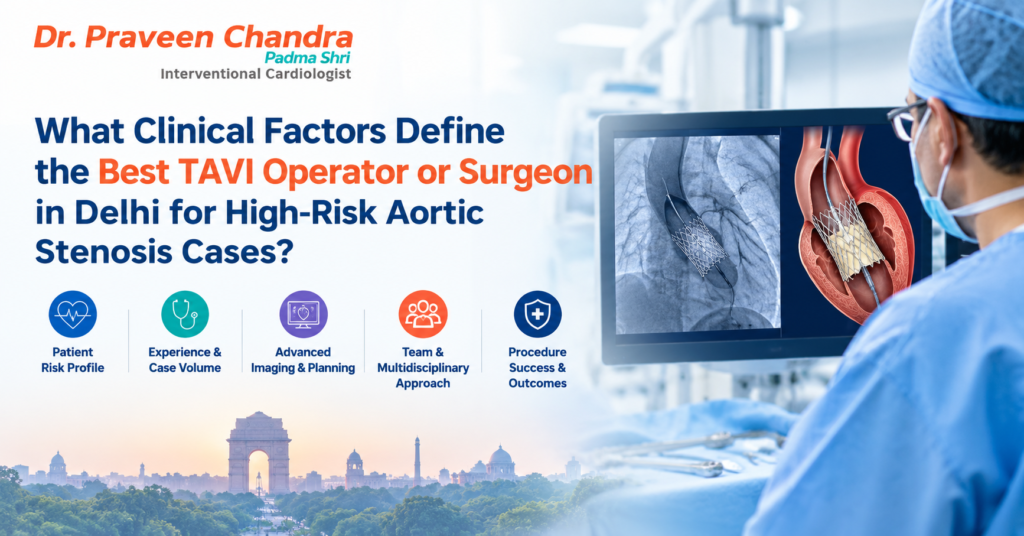
The choice of the appropriate specialist is a significant problem for patients suffering from aortic stenosis because they are at high risk with conventional surgery. TAVI, or transcatheter aortic valve implantation, is not merely a valve replacement procedure. It also implies the analysis of the patient’s state, symptoms, overall health, valve anatomy, access, and surgical risk.
When looking for the Best TAVI Operator or Surgeon in Delhi, one needs to look at the clinical expertise, proper patient selection, preparation for the procedure, and handling of difficult situations. Dr. Praveen Chandra is one of the specialists who can help in such cases, but the ultimate decision lies in the hands of each patient.
Why Operator Expertise Matters in High-Risk TAVI
TAVI procedure can be achieved by performing the technique through the catheter procedure instead of the conventional open-heart procedure to replace the valve. This, however, does not imply that all the patients who are subjected to the treatment are easy to treat, since high-risk individuals are faced with several conditions together with old age, heart failure, kidney problems, previous cardiac surgery, coronary heart disease, frailty, or even other ailments.
This is the reason why considering only the availability of TAVI procedures is not sufficient. The expertise of the clinicians who will be conducting the surgery is also an important factor that needs to be considered.
Clinical Factors to Consider When Choosing the Best TAVI Operator or Surgeon in Delhi
There is not one qualification alone that will determine which TAVI specialist is automatically the best for everyone. It would be better to assess different clinical factors together.
Clinical factor | Why it matters in high-risk TAVI |
Patient selection | Determines whether TAVI is clinically appropriate |
Heart Team assessment | Brings together different areas of cardiac expertise |
Advanced imaging | Helps assess valve anatomy and access routes |
Understanding of surgical risk | Helps compare TAVI with surgical valve replacement |
Procedural planning | Supports an appropriate valve and access strategy |
Management of complications | Important when treating medically complex patients |
Post-procedure care | Helps monitor recovery and possible complications |
Long-term planning | Considers the patient’s future cardiovascular needs |
Thorough Assessment Before Recommending TAVI
The successful TAVI program starts even prior to the intervention. It is necessary for the specialist to determine the degree of aortic stenosis, the presence of symptoms, ventricular function, the presence of comorbidities, and the risk of the procedure. It is not recommended to base the decision on either age or one risk score only.
Expertise in Advanced Cardiac Imaging
The role of imaging is vital in the planning of a TAVI. Echocardiography assists in the assessment of the valve and cardiac function, while CT imaging may provide important anatomical information to be used in the procedural planning. It is important that the specialist and the Heart Team know about such features as aortic valve anatomy, annulus, coronary anatomy, and vascular access. This information may affect the decision regarding which valve and procedural approach should be used.
Thus, the evaluation of the TAVI Operator or Surgeon should involve questions regarding the effect of imaging results on the treatment strategy.
Experience With Complex and High-Risk Patients
Experience is especially important when there are multiple risk factors or complicated anatomy. A surgeon who practices within an experienced multidisciplinary setting can assess the case from different perspectives.
These practical questions allow patients to ask about how their case will be assessed, what specialists will take part in the decision-making process, and how challenges during the procedure will be addressed.
Strong Heart Team Coordination
TAVI should not be considered an intervention of just one physician. In the Heart Team approach, different members, such as interventional cardiologists, cardio-thoracic surgeons, imaging specialists, anaesthetists, among others, are free to participate if necessary.
In the Heart Team approach, there will be assessment by these experts as to what would be the best course of action – TAVI procedure, surgical valve replacement, or any other approach- for the individual patient depending on certain patient-specific conditions.
Ability to Plan for Potential Complications
The high-risk TAVI procedure demands more than simply following the procedure. The treatment team needs to take into account potential problems in anatomy or other clinical aspects prior to conducting the procedure and to have adequate expertise to handle the issue in case it arises.
Patients assessing specialists need to be aware of the hospital setting and cardiac treatment team, instead of merely assessing the specialist himself.
How Patient-Specific Risk Changes the TAVI Decision
The phrase “high risk” cannot be used to describe all patients in the same manner. There are already existing scoring systems for surgical risk evaluation; however, not all variables that might affect a particular patient’s management are included in these scores.
Frailty, past history of chest surgery, vascular anatomy, organ function, and other clinical features can be a part of the final decision-making process. This is why two patients who both have severe aortic stenosis may receive different recommendations.
TAVI Is About More Than the Procedure
The ideal TAVI pathway involves assessment before and after treatment. It is important for patients to know what the goal of the procedure is, what the risks involved are for their specific case, and what follow-ups will be necessary. Decision-making is another critical aspect. The treatment strategy should take into consideration clinical features, anatomy, patient preference, and the overall treatment pathway. Questions that patients and their families can ask include:
Why has TAVI been proposed in this individual’s specific situation?
What qualifies the patient as high-risk in terms of surgery?
What does the imaging demonstrate regarding the valve and blood vessels?
Has a discussion with Heart Team occurred for this case?
What are the other possible treatment options?
What follow-up will be necessary post-TAVI procedure?
These questions are important in helping patients make an informed choice rather than selecting their specialist on the basis of reputation or convenience.
Choosing a TAVI Specialist in Delhi: What Should Patients Look For?
In the search for the Best TAVI Operator or Surgeon, patients need to think beyond just the procedure name. It is the entire clinical pathway – from diagnosis to imaging, from Heart Team assessment through to intervention – that really counts.
In the case of aortic stenosis being a high-risk condition, it becomes especially important to have good decision-making quality. The specialist who is suitable for such kind of task should be capable of assessing the patient’s personal risk level, knowing complex valve anatomy, working in a multidisciplinary cardiac team, and having a treatment approach tailored to the condition of the patient. It is most important for patients to know that their eligibility for TAVI is individual. Consultation with a specialist is needed to determine that.
Conclusion
Choosing the Best TAVI Operator or Surgeon in Delhi is more than just choosing between names. High-risk patients with aortic stenosis require a thorough clinical assessment, imaging, Heart Team discussion, procedural planning, and follow-up. These considerations will ensure that the treatment choice is based on the whole patient’s condition and not just one risk factor.
A patient suffering from heart disease may consider consulting Dr. Praveen Chandra for a comprehensive specialist review of their case, but what form of treatment will be suitable needs to be decided based on a thorough case evaluation. Any patient contemplating undergoing TAVI surgery should consult a heart specialist group.
Frequently Asked Questions
1. What is the purpose of TAVI?
TAVI is a catheter-based intervention performed to replace the aortic valve in properly selected patients who have aortic stenosis. It depends on the condition of the patient, their anatomy, and risk.
2. Is TAVI indicated for all patients with severe aortic stenosis?
No, not always. Selection between TAVI and surgical aortic valve replacement will depend on many issues such as age, anatomy, surgical risk, presence of comorbidities, life expectancy, etc.
3. Why is the Heart Team needed before TAVI?
Heart Team consists of various cardiac specialists who will evaluate the condition of the patient and make a decision regarding the proper treatment modality.
4. How is CT scanning used in TAVI planning?
The CT scan gives detailed information about the aortic valve and surrounding structures. This helps the clinicians plan the procedure based on the patient’s unique anatomy.
5. What questions can the patient ask before selecting a TAVI specialist?
The patient can ask about the specialist’s experience with difficult cases, the Heart Team that will be treating the patient, the imaging and evaluation process, procedural support, other treatment choices, and the follow-up plan.